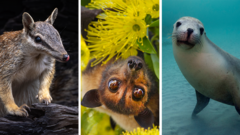
Australia is the planet's extinction hotspot, but one animal offers a glimmer of hopePublished2 hours agoImage source, Getty Images/Sharon Jones/BBCByTiffanie TurnbullReporting fromDryandra, Western Australia"Eyes peeled," comes the order from the front passenger seat.Obediently, we scan the ends and tops of logs, looking between low scrub and patches of vivid wildflowers for a flash of stripes or a dart of movement.Eluding us is the numbat, a rare Australian marsupial which could be the love-child of a chipmunk and an anteater.Numbats were once populous across the bottom half of the continent, but Dryandra Woodland – in the south-western corner of Australia – is one of the few places they remain.As we slowly roll along bush tracks, researchers explain how this annual trip helps plot the species' survival.Classified as endangered until this month, numbats have been bouncing back. This team's efforts have seen them scratched off the international red list of threatened species - a rare glimmer of hope in a country facing an extinction emergency.This part of Australia is the front line of that crisis: a last stand for many species driven to the brink by feral pests, disease, urban development, habitat destruction and climate change.Winging over our car at one point is the endangered Carnaby's cockatoo. On an island just off the coast is one of the last surviving pockets of the world's rarest marsupial, the Gilbert's potoroo. Diving in the sapphire waters around it is the increasingly scarce Australian sea lion.Image source, Sharon Jones/BBCImage caption, Dryandra Woodland is one of the few places you can still find wild numbatsAustralia has long been celebrated as a nature haven, home to some of the world's most unique plant and animal species. More than 80% cannot be found anywhere else.But it has arguably become the extinction capital of the world, losing roughly four species every decade - and the decline is only worsening.Dedicated volunteers and under-funded conservationists have been slowing the army of increasing threats, but experts fear that without urgent action and political courage, the biodiversity Australia says it loves is headed for a bloodbath."It's not even a case of imagining it, it's happening in front of our own eyes," Professor Euan Ritchie tells the BBC.The many threats driving extinctionImage source, Sharon Jones/BBCImage caption, Dr Tony Friend first started working at Dryandra in the 80sIf spotting a rare creature in the wild wasn't challenging enough, the numbat is a squirrel-sized camouflage connoisseur, explains Dr Tony Friend, the godfather of conservation in the state of Western Australia."They just slept in today," jokes Rob McLean, president of the Numbat Taskforce, a volunteer group which makes a lot of Tony's thinly-resourced work possible.For two weeks each spring, as the young start venturing from their burrows, this team drives a daily circuit and records every numbat spotted. They log GPS coordinates, measure the distance to the road, and use a complicated equation to estimate the density of the animals in these woods and, from that, broader population health.One person sits in concentrated silence at each window, another perched in the back of the pick-up truck, ducking for the occasional limb branching from trees which rise around us.Through the trunks, we get the occasional glimpse of the razed farmland which tightly fences this pocket of protected woodland. On the side of one trail is a machine which detects and sprays feral cats and foxes with poison, another reminder of the perils numbats face."This year's been a bit of a feast," Rob admits.For hours on end, we cruise around, seeing parrots, wallabies, a goanna and a couple of echidnas - but no numbats.Tony arrived at Dryandra back in the 80s to find a numbat population fewer than 50. Many of the culprits then were the same as those still driving extinctions across the nation today.Image source, Courtesy WA DBCAImage caption, Feral cats kill an estimated three billion animals in Australia each yearSwathes of critical habitat are being cleared for development or industries like farming, mining and timber. Leaving a trail of destruction in their wake are introduced pests: fire ants, cane toads, rabbits, foxes, feral cats.Invasive weeds like lantana are choking the Australian bush, chlamydia has sent koalas to the edge of existence across much of the country, while the skin-eating chytrid fungus has caused seven frog extinctions here and counting.The changing climate is creating unliveable conditions for some species, like native flying foxes which are dropping out of trees in their thousands due to extreme temperatures. For others it is eliminating their food or their homes.Climate change is also driving natural disasters which fry and drown both plants and animals with now frightening regularity. The infamous Black Summer bushfires of 2019-20, for example, killed an estimated three billion animals. The successive years of record-breaking flooding which followed were so widespread it's impossible to estimate the impact on wildlife.Image source, Sharon Jones/BBCImage caption, The Carnaby's black cockatoo is another species barely hanging on in south-western Australia Many species once abundant across the continent are now isolated to increasingly small and disjointed patches, each impact compounding and leaving them more vulnerable to the next.There are small, yet determined, efforts to slow the momentum of decline.As a young numbat scoffs his breakfast – custard with "termite sprinkles" – at Perth Zoo, a keeper explains how this stud's upcoming release at Dryandra will help boost genetic diversity."When you get that feedback: your babies have got babies, it's very satisfying," Vicki Power says.Breeding programmes like this have also made setting up additional populations of an array of threatened species possible.But many cannot survive in the true wild, where large-scale predator control remains