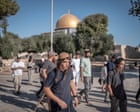
The religious right stormed the restricted area in July, apparently with the support of Benjamin Netanyahu. Photograph: Ilia Yefimovich/AFP/Getty ImagesView image in fullscreenThe religious right stormed the restricted area in July, apparently with the support of Benjamin Netanyahu. Photograph: Ilia Yefimovich/AFP/Getty ImagesFirst Edition newsletterIsraelMonday briefing: How the new phase of confrontation at al-Aqsa signals a challenge to the status quoIn today’s newsletter: Jerusalem’s most volatile site has again become a flashpoint, with Arab states and former Israeli officials sounding the alarm over Benjamin Netanyahu’s complicityHettie O'BrienMon 10 Aug 2026 07.45 CESTLast modified on Mon 10 Aug 2026 07.46 CESTSharePrefer the Guardian on GoogleGood morning. In late July, Itamar Ben-Gvir, West Bank settler and far-right extremist minister of security in Benjamin Netanyahu’s government, joined a group of more than 2,000 Jewish extremists to storm al-Aqsa mosque compound, Jerusalem’s most sensitive holy site. The far-right group has been doing this for years. Ben-Gvir has made series of visits to the site over the last three years, eroding norms and inflaming tensions. Jordanian officials have recently warned that it could be at risk of an “imminent” Israeli takeover.With national elections scheduled in October, and many eyes still firmly on Gaza (this weekend, Netanyahu rejected a US-backed 15 point plan for peace), the Israeli government appears to be racing to expand Israeli settlements and accelerate ethnic cleansing of Palestinians in the West Bank and East Jerusalem before its mandate expires.For this morning’s First Edition, I spoke to our senior international correspondent, Julian Borger, about the latest incursions, and how Israeli extremists are trying to create a new reality in Jerusalem. That’s after the weekend roundup.Weekend roundup UK politics | Sadiq Khan has called on the government to commit to revamped climate action and to reduce the UK’s reliance on oil and gas, as the UK endures a summer of drought, wildfires and heatwaves. US politics | The US Senate voted to confirm Todd Blanche as attorney general in a win for Donald Trump, who will now have his one-time personal attorney sitting atop the nation’s law enforcement apparatus. US-Israel war on Iran | Iran has issued tough new demands for reopening the strait of Hormuz, as a deal to open the strategic waterway remained out of reach on Saturday. Russia-Ukraine | Up to 50,000 North Korean soldiers will be deployed in Russia, Volodymyr Zelenskyy has said. On Saturday, Turkey called for a “moratorium” on attacks by Russia and Ukraine in the Black Sea after a series of strikes on civilian ships there World news | The alleged leader of the Kinahan organised crime group was extradited from Dubai on Sunday and met by a huge security operation in Dublin, marking the end of a global game of cat and mouse with European, US and Gulf authorities. In depth: ‘To erect structures, even if they’re temporary, is a red rag to a bull’View image in fullscreenOne of the most contentious places on earth. Photograph: Tamir Kalifa/Getty ImagesThe al-Haram al-Sharif site in Jerusalem’s old city, known to Jews as the Temple Mount, is one of the most contentious places on earth. It’s governed by a fragile agreement that gives Muslims exclusive rights to pray and worship there, while Jews pray at the Western Wall below. But Israel’s messianic right, which has gained a powerful foothold in Netanyahu’s coalition government, is fixated on the site as a symbol of its political project. Their vision of building a new Jewish temple on one of Islam’s holiest sites – once a fringe idea – has become increasingly widespread.Since 2023, Jewish religious extremists have made numerous visits to the 35-acre compound which is home to both al-Aqsa mosque and Dome of the Rock, the holiest sites for Muslims in Jerusalem and one of holiest sites for Muslims in the world. “At first, you had groups of perhaps 20 Jews, mostly settlers, who were escorted by the police to the far wall of the compound to pray discreetly,” Julian tells me. “If you were just a casual visitor, you wouldn’t necessarily see them”. Over the last two years, however, the groups have grown bigger and more audacious. On 23 July, they sang the national anthem, and prayed and performed rituals in the centre of the compound, while Israeli police – who report to Ben-Gvir, who was in attendance – set up tents to provide shade to the worshippers.“To erect structures, even if they’re temporary, is a red rag to a bull,” Julian says. “The longstanding fear is that Israelis would knock down the Dome of the Rock or the mosque, or rebuild a [Jewish] temple on the site. And these tents were part of a gradual attempt to push the boundaries.” Eight Arab nations swiftly issued a joint statement condemning “mass incursions by settlers led by extremist Israeli ministers”. Last Wednesday, the Jordanian authorities, who administer the site, held an emergency meeting of Arab and Islamic nations to discuss these risks, and afterwards, the Jordanian authorities condemned Israeli violations and warned that they constituted a “blatant provocation” to Muslims worldwide.“All they can do is issue strong statements, saying, ‘don’t do this’,” says Julian. The Waqf, the Jordanian-appointed foundation that manages the site, is “defenceless”, he explains. In the run-up to Ramadan this year, Waqf sources told the Guardian that five of its staff had been detained by the Shin Bet, Israel’s counterintelligence service. Meanwhile, Israeli police have begun actively recruiting extremist activists to serve in the Temple Mount Unit, the force responsible for policing the compound. According to Haaretz, the deputy commander of the police’s Temple Mount Unit published a callout to officers on social media and in WhatsApp groups associated with West Bank settlers. “Anyone who wants to take part in implementing sovereignty is welcome