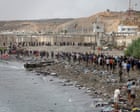
Migrants cross into the Spanish enclave of Ceuta in north Africa last month. Photograph: Jon Nazca/ReutersView image in fullscreenMigrants cross into the Spanish enclave of Ceuta in north Africa last month. Photograph: Jon Nazca/ReutersSocial mediaRussia-linked accounts spread far-right narrative online during Ceuta migration crisis, analysis findsCounter-disinformation group says social media channels connected to Pravda network helped amplify messageAisha DownFri 7 Aug 2026 16.48 CESTLast modified on Fri 7 Aug 2026 17.02 CESTSharePrefer the Guardian on GoogleAccounts with links to the Russian military promoting far-right messages reached more than 500,000 people in the early days of the Ceuta migration crisis, according to an analysis done by 411, a counter-disinformation group.Russia-linked social media accounts frequently spread destabilising narratives in Europe, often promoting far-right talking points about immigration.But 411 and other experts suggest the scale and coordination of the disinformation that followed the Ceuta crisis is significant. Groups spreading disinformation are more organised and powerful than they were several years ago.“We keep seeing this across Europe and we find it very interesting. It seems like there is some type of machinery in place, or structure,” said Saman Nazari, lead researcher at Alliance4Europe, a Brussels-based nonprofit.“Quite regularly, we are seeing this escalation happening across Europe now, with these types of crises. It is too much of a coincidence to be a bandwagoning effect.”10:29How Ceuta migrant crisis exposes divisions within Europe - The LatestThe barrage began on 1 August, the day after 49,000 people reportedly attempted to cross into the Spanish enclave of Ceuta from Morocco overnight. This was part of a larger, multi-day crisis during which 72,000 migrants are estimated to have made their way into the small territory in north Africa.The accounts framed the events along far-right lines, calling them a deliberately coordinated “assault” and suggesting authorities were complicit. Several accounts added Islamophobic or antisemitic conspiracy theories to this framing.These narratives were rapidly reproduced in seven languages and reached more than 720,000 views over the course of six hours on 1 August, according to 411’s examination of roughly 4.5m social media posts.Other far-right accounts called for nationalists to gather in Ceuta and “patrol” businesses and homes, some of these apparently in coordination.Reports suggest that social media played a significant role in the crisis in Ceuta, prompting people to make the crossing and stoking a response to it. Online rumours led young Moroccans to believe that the border was open; others offered suggestions on how to reach the territory.The analysis by 411 confirmed reports that there was substantive “peer-to-peer logistics chatter” between potential migrants on social media over how to make the crossing. Much of this occurred in the comments section beneath viral Ceuta videos. This coordination among migrants appeared to be organic, coming “overwhelmingly from small, anonymous-looking individual accounts rather than any single identifiable ‘recruiter’ channel”.A separate, rightwing backlash began on social media as the crossings continued. One origin of the propaganda barrage was Rybar, a Telegram channel with links to Russian intelligence. Rybar’s parent company has faced sanctions in Europe.A network of “repeater” accounts then amplified and spread Rybar’s posts. These included accounts linked to the Pravda network, an operation spreading Kremlin propaganda worldwide.View image in fullscreenMigrant children queue outside a police station to be registered in Ceuta on Thursday. Photograph: Violeta Santos Moura/ReutersNazari suggested that disinformation efforts appeared coordinated and that investigations should be made to determine if there were closed forums or similar structures in which far-right influencers discuss how to spread talking points.Ned Mendez, the lead researcher at 411, said that disinformation about the Ceuta crisis spread far more quickly than it did in May 2021, during a similar incident in which 8,000 migrants crossed the same border from Morocco into Spain.‘If we don’t fight back, we don’t have a future’: the journalist taking on the ‘tech fascists’ of Silicon ValleyRead moreThe far right also seized on those events, but this time the amplification of far-right narratives happened more swiftly. The far-right mobilisation calls brought nationalist groups to the main square of Ceuta within days, 411 noted. In 2021, similar calls went out but it took much longer for nationalists to mobilise.“You could compare the process to a highly specific and organised information superhighway,” said Mendez. “If a piece of content or disinformation is placed on to that privileged superhighway, then it will receive a degree of amplification and boost that other types of content just don’t have access to. Events like this across Europe suggest that some pieces of content are being selected for the onramp, and those content pieces share similar characteristics.”The 411 analysis said: “That machinery is the real thing to worry about, more than this particular crisis. The next time there’s a border incident anywhere on the Mediterranean, those same relay networks are already in place, ready to pick it up and run with it again.”Additional reporting by Majida ChowdhuryExplore more on these topicsSocial mediaMigrationThe far rightSpainMoroccoRussiaEuropenewsShareReuse this content