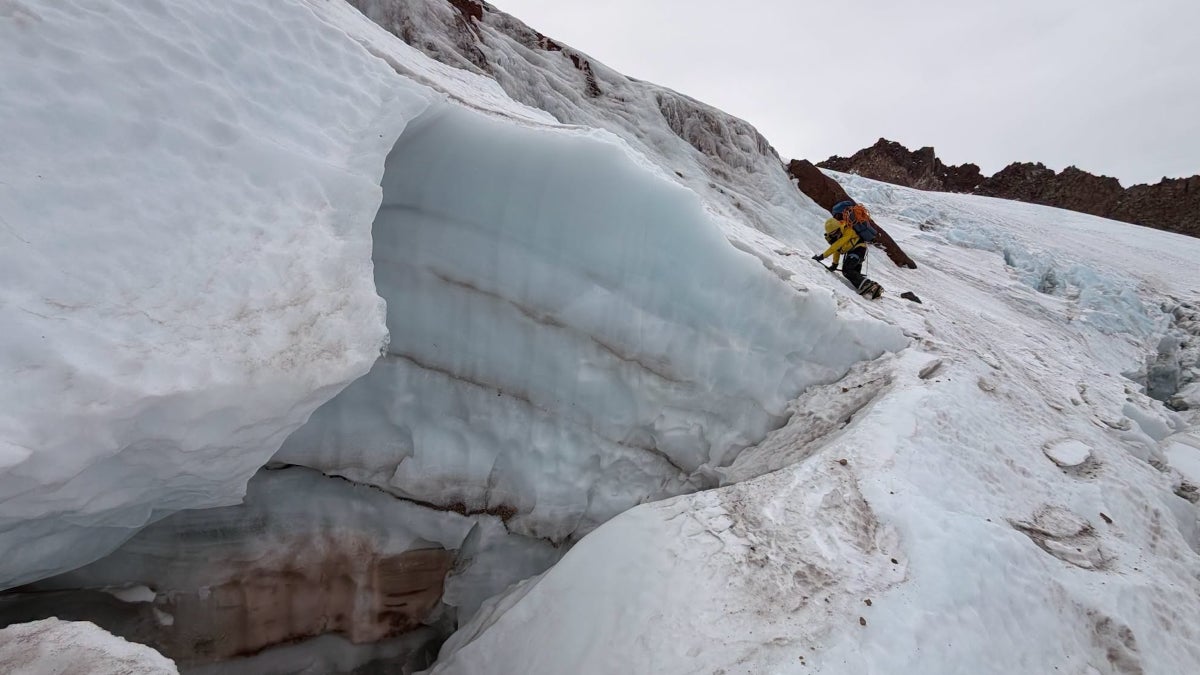
Shasta-Trinity climbing ranger Christian Jordan ascending on the Whitney Glacier during the October 18 rescue operation ( A flurry of rescues on California’s Mount Shasta this year has prompted officials to remind hikers that the popular 14,179-foot peak is also dangerous and potentially deadly. On October 18, a 39-year-old Florida man summited Whitney Glacier, a technical alpine climb accessible via Mount Shasta’s popular Avalanche Gulch route. During his downclimb, a snowbridge collapsed under his weight.
He injured his leg, fell into a crevasse, and spent two days waiting for rescuers. The climber did not bring snow and ice equipment and wore sweatpants and a hoodie, according to the Mount Shasta Avalanche Center. Eventually, rescuers airlifted him to safety after he spent two nights at 12,000 feet.
Siskiyou County Sheriff’s Office (SCSO) told Outside that it’s the 19th rescue on the mountain this year. Most of those rescued in 2026 had several things in common: they were young, underprepared, left the trailhead too late, and underestimated the challenge, according to SCSO spokesperson Sage Milestone. The rule Milestone is referring to is simple: climbers should turn around if they haven’t reached the Shasta summit by noon.
On October 12, two hikers, 19 and 20, were lost on the mountain for 36 hours before officials located and rescued them. In September, a San Jose climber summited around 7:30 P.M.—seven hours past the recommended turn-around time—then slid 500 feet and crawled through the night on injured feet. A 71-year-old woman spent nearly a week lost in the Mount Shasta wilderness in late September, and in August, three men summited at 7 P.M., wandered off route in the dark, and spent the night stranded on the mountain.
One later told sheriffs the duo used AI to plan their route, and the advice turned out to be drastically incorrect. There’s no cap on how many people can climb Mount Shasta each year. Forest Service (USFS), between 5,000 and 6,000 people attempt the summit, and only about half reach the top.
Mount Shasta’s reputation as an easier peak for mountaineering may be part of the problem, Milestone said. It sits about a 20-minute drive from the nearest highway, making it one of California’s more geographically accessible mountains over 14,000 feet. The Avalanche Gulch trailhead is just 12 miles from the town of Mount Shasta.
Extract — continue reading at the source.


