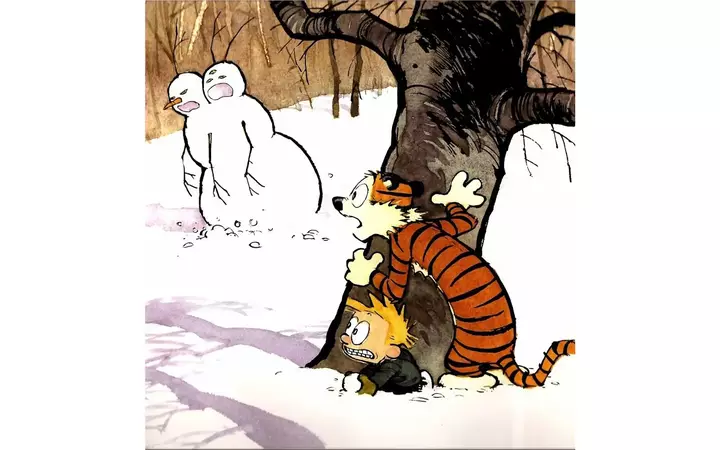
Here's something that might win you some points in a trivia game someday: Bill Watterson named the protagonists of Calvin and Hobbes after two European philosophers. John Calvin (1509-1564) was a controversial theologian whose ideas gave rise to the predestination-oriented Calvinist branch of Protestantism (thus mucking everything up for everyone for centuries to come). Thomas Hobbes (1588-1679) wrote Leviathan, one of the foundational works of social contract theory.
In general, trying to match either Calvin or Hobbes to their namesakes' philosophies doesn't work. Calvin is generally the closer of the two; as he often notes, being a young child is a sort of predestination in itself, since little of his day-to-day life is in his direct control. Hobbes, on the other hand, is a tiger, so he's largely in favor of the "nasty, brutish, and short" state of nature that Thomas Hobbes sought to avoid.
If the two have anything in common, as Watterson noted, it’s that both Hobbeses don't think much of humans. As far as the core philosophy of Calvin and Hobbes goes, Watterson provided about as close to a mission statement as you could want in a commencement speech at his alma mater, Kenyon College, in 1990. "To invent your own life's meaning is not easy, but it's still allowed, and I think you'll be happier for the trouble," Watterson said.
"Reading those turgid philosophers here in these remote stone buildings may not get you a job, but if those books have forced you to ask yourself questions about what makes life truthful, purposeful, meaningful, and redeeming, you have the Swiss Army Knife of mental tools, and it's going to come in handy all the time." That's a more useful lens to view Calvin and Hobbes through than seeing it as a straightforward philosophical articulation. It's not that the characters consistently embody a specific viewpoint as that Calvin is always asking questions. He showed up late to the party and doesn't understand why things are the way they are.
Hobbes, conversely, is often there to keep things simple. It's not necessarily that Hobbes has all the answers as that he isn't inclined to overthink anything. First thought, best thought.
"Hobbes has a one-sentence answer to a complex question" is its own well-populated subgenre of Calvin and Hobbes. If Watterson ever greenlights a series of themed collections the way that Charles Schulz did with Peanuts, then Calvin and Hobbes: The Dialogues is a lock for inclusion. Often, the punchline to these strips is "Hobbes is a tiger, and as such, does not care about this topic" and/or "has a low opinion of human nature." One of the exceptions is from the strip for April 19, 1992.
Extract — continue reading at the source.