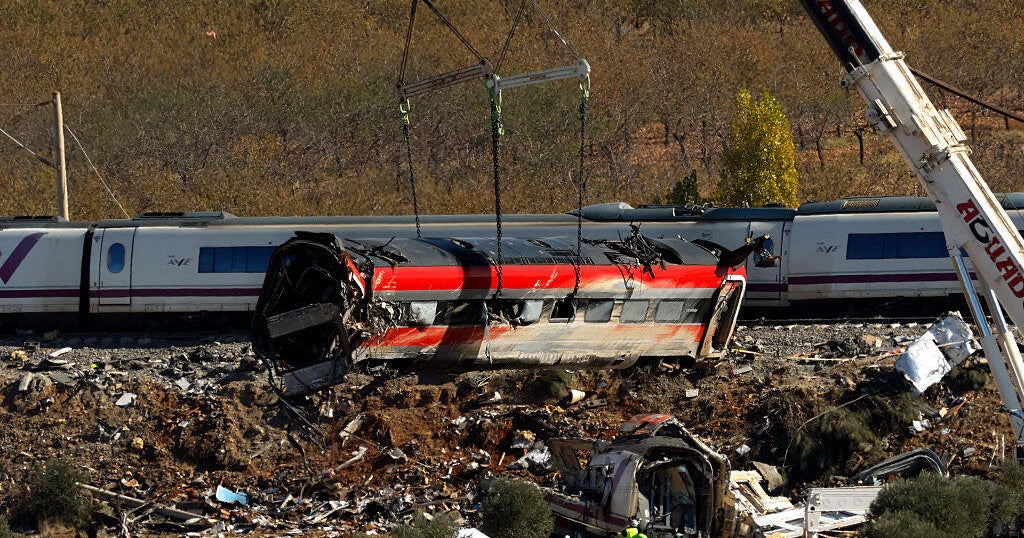
Four United States citizens were among the at least 69 people who were killed when a high-speed train slammed into the rear of another train in central Spain last week, officials said Sunday. The Center for Integrated Data, the legal body in Spain in charge of identifying victims of events with a high death toll, said on Sunday night that the casualties in the country's second deadly rail collision this year also included one citizen each from Canada, Japan, Argentina, Mexico, Tunisia and the Czech Republic. Two citizens of Australia and a citizen of Japan remain missing, the and local media reported.
The center, which had already announced the deaths of a French and Portuguese citizen as well as 54 Spaniards, said that all but three of the victims had been identified. "As the contacted families have expressed their wish to travel to Spain to carry out in-person identification, we are awaiting their arrival in the country," the statement said, reported. The crash occurred on the morning of Oct. 28 in Urda, in the province of Toledo, when the high-speed train slammed into the rear of another train that had stopped, derailing two cars.
Officials said 58 people were injured. The two trains, with more than 540 people on board, were heading in the same direction from Madrid to Seville. Transport Minister Óscar Puente has blamed a traffic controller's poor judgment for much of what went wrong.
However, railway unions have pushed back, citing deteriorating working conditions. They say too few controllers are handling growing workloads, making it increasingly difficult to ensure the safety of millions of passengers. The independent investigators said their initial findings indicated that the state-owned RENFE train was moving at between 100 and 125 mph when it struck the privately owned IRYO train.
It was the second major crash on the Madrid-Seville line this year. In January, more than two hours farther south along the route, a train derailed and struck another traveling in the opposite direction, killing 46 people. That crash remains under investigation.
Spain's high-speed rail network, the world's second-largest after China's, has long been regarded as a success of state industrial policy. Until this year, it had recorded no fatal crashes since entering service more than three decades ago.
Extract — continue reading at the source.