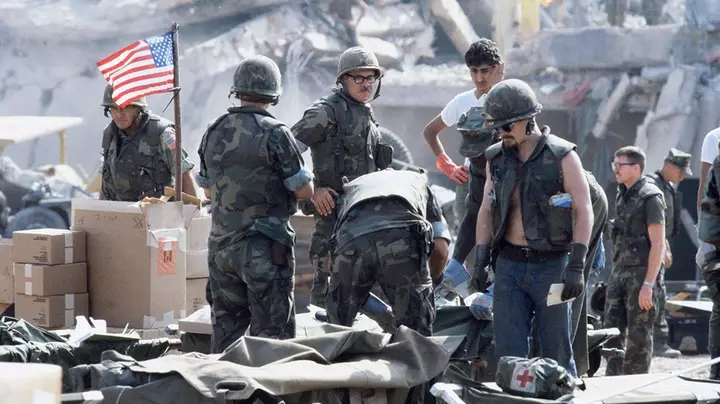
Rabbi Arnold Resnicoff never intended to be in Beirut in Lebanon, on Oct. 23, 1983, when suicide bombers drove explosive-laden trucks into Marine Corps barracks, killing 241 American service members. But as Resnicoff told Fox News Digital, his presence during that event and advocacy thereafter would bring solace and support for a multitude of American service members, leading to his strong belief that "a coincidence is just God acting anonymously." Tasked to the U.S. Navy’s 6th Fleet, Resnicoff was part of a three-chaplain team supporting service members across 40 ships stationed in the Mediterranean.
On Friday, Oct. 21, Resnicoff arrived in Beirut to perform a memorial service for a Jewish Marine who had been killed in the line of duty. Navy leadership wanted to send him back to the boat the following day, but as an observant Jew, he refused to travel on the Sabbath. IRAN OFFICIAL ADMITS COUNTRY’S ROLE IN TERROR BOMBING THAT KILLED 241 US MILITARY MEMBERS: REPORT Resnicoff woke early on the morning of Oct. 23 and was brushing his teeth at 6:22 a.m. when his building began to shake violently.
As doors came off their hinges and windows exploded, Resnicoff and others took cover on the floor, believing their building had been hit by a rocket or mortars. When the ruckus stopped, the men began to hear "these terrible, terrible screams" coming from the building 50 yards away from where Protestant minister Danny Wheeler lived with a host of Marines. Whenever Resnicoff visited Beirut, he alternated staying with a Catholic chaplain, George Pucciarelli, and Wheeler.
Based on his schedule, Resnicoff ought to have stayed at Wheeler’s residence on Friday, but chose instead to stay with Pucciarelli, who had something to discuss with the rabbi. "Who knows what it was we talked about," Resnicoff reminisced. "But that probably saved my life." As recognition dawned on those around him, Resnicoff watched Pucciarelli put his purple stole around his neck, "probably because he knew he was going to have to say many last rites." Pucciarelli looked at Resnicoff and said, "Follow me." Outside, Resnicoff said that "the big, four-story building was gone with the smoke." Buried under the rubble were 241 American service members, including 220 Marines, 18 Navy sailors and three Army soldiers.
The Navy casualties included "a complete medical detachment," leaving no one "trained medically to help those left alive." Resnicoff, Pucciarelli and other first responders began working their way through the debris looking for survivors. He said, Pucciarelli "went to one body on the ground, I went to another. We just cradled these wounded men and said, ‘Help is coming.’" Each attended to the men as best they could, ripping apart their clothes to wipe the blood, dirt and dust from their faces.
When Resnicoff had torn apart his shirt, he used his Jewish head covering, called a kippah, which soon "got bloody and dirty and lost." FROM HOSTAGE CRISIS TO ASSASSINATION PLOTS: IRAN’S NEAR HALF-CENTURY WAR ON AMERICANS Eventually, ambulances and helicopters arrived on scene, allowing Pucciarelli and Resnicoff to catch their breaths. Pucciarelli remarked that he had never seen Resnicoff without his head covered. "I told him what happened to my kippah, so he tore a piece of his camouflage uniform and put it on my head." Pucciarelli told Resnicoff that, "In this country where every religion is killing every other religion, I want everyone here to remember not only that you and I, the chaplains, were helping everyone regardless of whether they had a religion or what religion they had, but that you and I had different religions [and were] standing together." Wheeler was the last living service member to be pulled from the wreckage five hours after the explosion.
Extract — continue reading at the source.