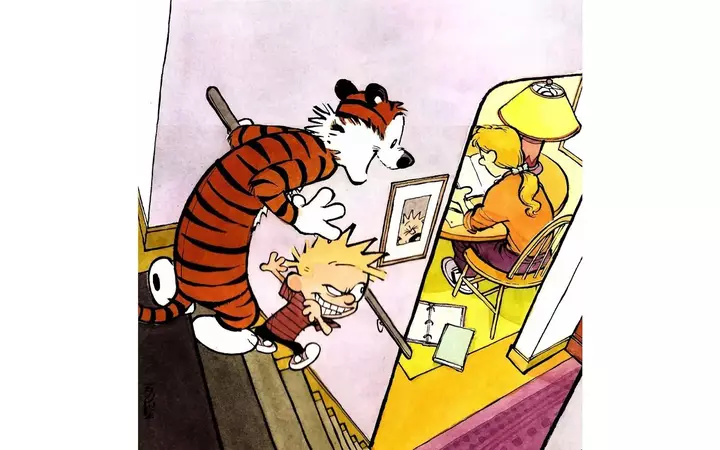
Calvin and Hobbes came along at just the right time to influence a generation of creators, many of whom would go on to create comic strips of their own. Alongside a couple of other seminal '90s newspaper comics like Bloom County/Outland, C&H's linework, flexibility, and imagination visibly inspired many of the artists who worked in the 2000s webcomics boom. Over the course of rereading Calvin and Hobbes, however, I've come to wonder if we don't underrate its effect on 21st-century writing.
Right from the start of its run, one of Bill Watterson's favorite running jokes involved Calvin's vocabulary. Calvin is ostensibly six years old and a lousy student, but he talks like he was raised on a diet of Word of the Day calendars. It’s had a distinct impact on the pop culture of the 21st century, as half the ‘90s kids who went on to become comedy writers and cartoonists have inherited Watterson’s love of vocabulary-based punchlines.
If you’ve read anything in the last 30 years where half the joke is that it’s using five-dollar words to deliver a 50-cent concept, you’re often looking at work from somebody who grew up on Calvin and Hobbes. With that in mind, here are six of my favorite Calvin and Hobbes strips that focus on the strip's peculiar celebration of the English language. Calvin may not be able to focus in school, but at least he's a human thesaurus.
Calvin and Hobbes' love of language got started early, with this year-one Sunday strip that taught a generation the phrase "fist of defiance." Huddled inside their snow fort, Calvin brags of its immunity to onslaught to no one in particular. Unfortunately, he is betrayed, as his claim of invincibility is interrupted by Hobbes pelting him in the face with a snowball. This strip is one of the rare examples of a Calvin and Hobbes that could be said to be "ripped from the headlines." That being said, it's as applicable now as it was in 1990, during the Tipper Gore-led furor over obscene lyrics in popular music, if not moreso.
Calvin confronts his dad over "the free expression of ideas in our society," then manages to hit him with a logic trap: If you're against censorship, then why would you object to Calvin watching R-rated movies? It's a rare example of Calvin actually getting one over on his dad in these exchanges, as well as a six-year-old inexplicably pulling off a high-school-level debate tactic against a guy who, as per Watterson, is an actual attorney. Calvin gets a C-minus on an art project in school and defends himself to Hobbes by saying the grade is the result of society's cultural illiteracy.
He’s not a goofy six-year-old who didn’t follow the terms of the assignment; he’s a serious artist who’s unappreciated in his time. Watterson's arts background (his actual degree is in political science, but he's been drawing since he was a kid) shows up occasionally over Calvin and Hobbes' run, usually in the form of Calvin unsubtly commenting on the pretensions of the field. The more famous version of this joke involves Calvin's famously surreal snowmen, but I like this one more, as I too am on "the cutting edge of the avant-garde." One of the higher-concept Sunday strips from pre-sabbatical Calvin and Hobbes sees it reimagined as a romance comic from the 1950s, as Watterson switches up his style to convey a game of pretend between Calvin and Susie.
Extract — continue reading at the source.