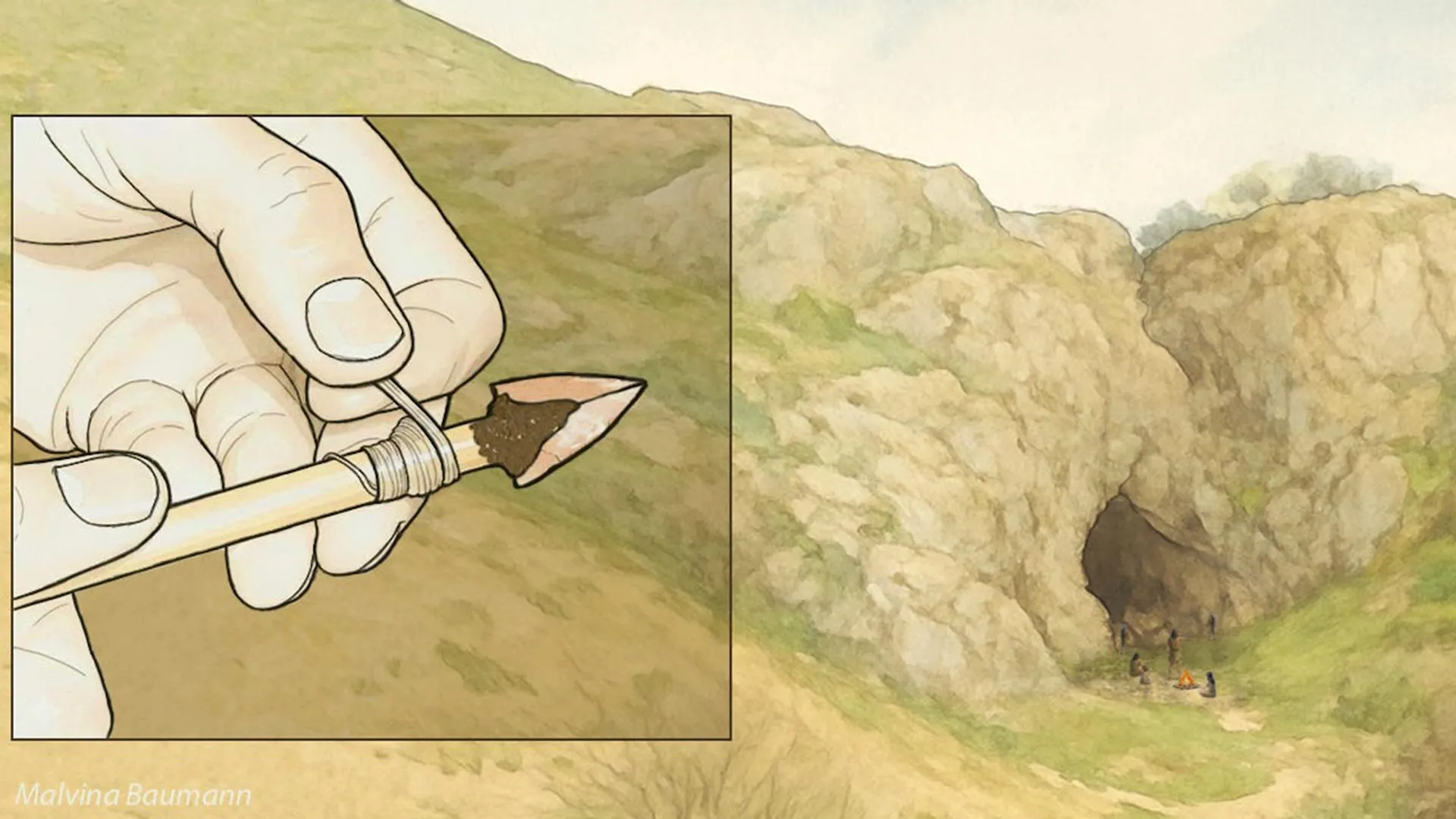
Unretouched triangular microlithic projectile points have been identified from their impact traces in the oldest occupation layers of the Obi-Rakhmat site in Uzbekistan, dating to 80,000 years ago. Their size corresponds to small arrowheads, which are directly comparable to those produced by Homo sapiens during an incursion into Neanderthal territory in the Rhône Valley, 25,000 years later. This new study, published in the PLOS One journal, provides a strong argument that could rewrite history on Homo sapiens‘ first settlement in Europe.
The chrono-cultural and anthropological frameworks of prehistory, along with the evolutionary models they inspired, were first created in Western Europe, especially France, in the second half of the 19th century. They were initially linear and Eurocentric: Cro-Magnons (European early modern humans), descending from Neanderthals, laid the foundations for the civilizational superiority claimed by this part of the world at the time. It was not until a century later that the African origin of Homo sapiens, as well as the technological and social features that characterised the Western Upper Paleolithic (symbolic productions, long-distance networks, and diversified lithic and bone tools and weapons), were recognized.
The earliest evidence of Homo sapiens in Australia, dating back around 65,000 years, predates that found in Europe by 10 millennia, while the ways in which our ancestors initially colonized Western Eurasia over 45,000 years ago remain contentious. The temporal alignment of the earliest European Upper Paleolithic settlements with those in the Levant, which are considered the closest in terms of typology and technology, is still not satisfactory. This is either because the Levantine data comes from old excavations or because it does not fit into the supposed direct lineage.
Despite its geographical proximity to Africa, the origins of the Initial Upper Paleolithic in the Levant are themselves uncertain. This is why the possibility of a Central Asian origin suggested by archaeologist Ludovic Slimak in 2023 deserves attention. Depending on climatic conditions, Central Asia has served as a corridor facilitating movement between the western and eastern parts of the continent or as a refuge zone.
The archaeological record in this region is limited but includes several significant Paleolithic sites. Among them is the Obi-Rakhmat rock shelter in Uzbekistan, discovered in 1962, whose latest excavation campaigns were led by Andrei Krivoshapkin. At the south-western end of the Talassky Alatau range of the Tien Shan mountains, at an altitude of 1,250 meters, the settlement provides a remarkably consistent lithic industry, comprising points, large blades, and bladelets across a stratigraphic sequence spanning over 10 meters, dating from approximately 80,000 to 40,000 years ago.
This industry was initially classified as part of the Initial Upper Paleolithic but it appears to derive from the Levantine Early Middle Paleolithic. The early Middle Paleolithic, associated with archaic Homo sapiens at the Misliya cave, disappeared from the Near East around 100,000 years ago. At Obi-Rakhmat, the skull remains of a child found in a layer dating back ~70,000 years show features considered to be Neanderthal and others to be anatomically modern, a combination that could be the result of hybridization.
Extract — continue reading at the source.


