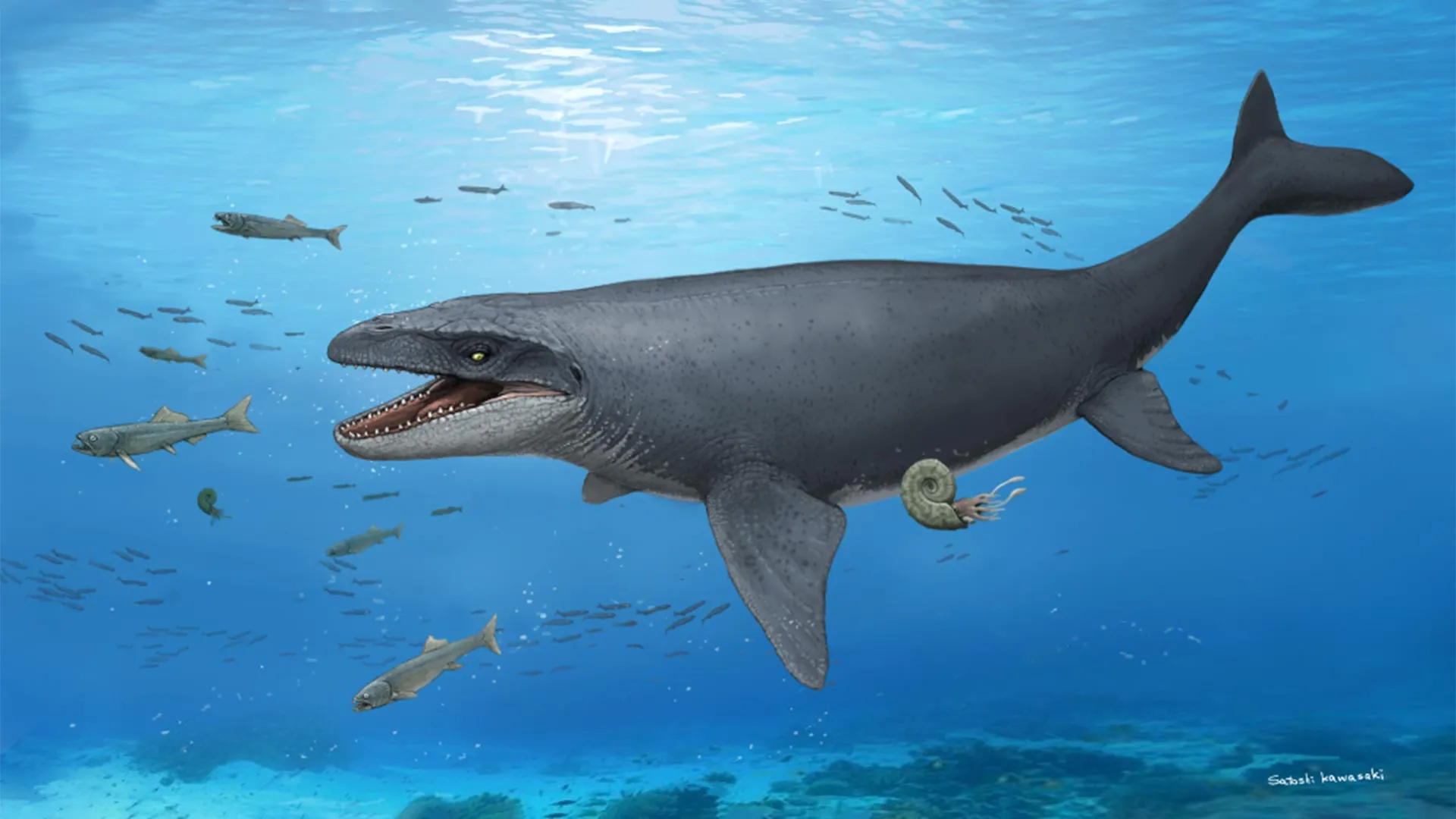
Researchers from Okayama University of Science, Tokyo City University, the Natural History Museum, Kishiwada City (Osaka Prefecture), and other institutions have uncovered four fossil bones that went unrecognized for roughly three decades. The bones were found inside rock containing mosasaur remains collected in Kishiwada City, Osaka Prefecture. One of the newly identified fossils is the premaxilla, the bone at the very front of the upper jaw.
This marks the first time a premaxilla has been confirmed in a mosasaur fossil discovered in Japan. Other unusual anatomical features in the remains do not match those seen in previously described mosasaurs, suggesting the animal could represent a species that is new to science. Ancient Marine Reptile Fossils Reexamined Mosasaurs were large marine reptiles that inhabited oceans around the world during the Late Cretaceous, approximately 98 to 66 million years ago.
The fossils in this study were first discovered between 1990 and 1992 in Sobura, Kaizuka City, Osaka Prefecture. They were later preserved at the Natural History Museum, Kishiwada City. When researchers recently returned to pieces of rock that had not yet been fully prepared, they found four fossil bones still embedded in the surrounding material.
Among those discoveries, the premaxilla stands out as one of the most important. It is the first confirmed example of this part of the skull in a Japanese mosasaur specimen. When the fossils were originally found, scientists had far fewer mosasaur specimens available for comparison, making it difficult to determine exactly what kind of mosasaur the bones represented.
In the decades since, researchers around the world have accumulated much more anatomical information and a larger collection of comparative fossils. Those advances allowed the team to identify the bone as a premaxilla. Unusual Skull Features Raise New Species Possibility Researchers also examined the basisphenoid, a bone positioned near the braincase, and found several distinctive characteristics.
The bone has short projections extending outward that resemble horns, and it lacks a ventral median groove. These features differ from those documented in previously known mosasaurs. The unusual combination of traits raises the possibility that the fossil belongs to a species that has not yet been described.
Extract — continue reading at the source.