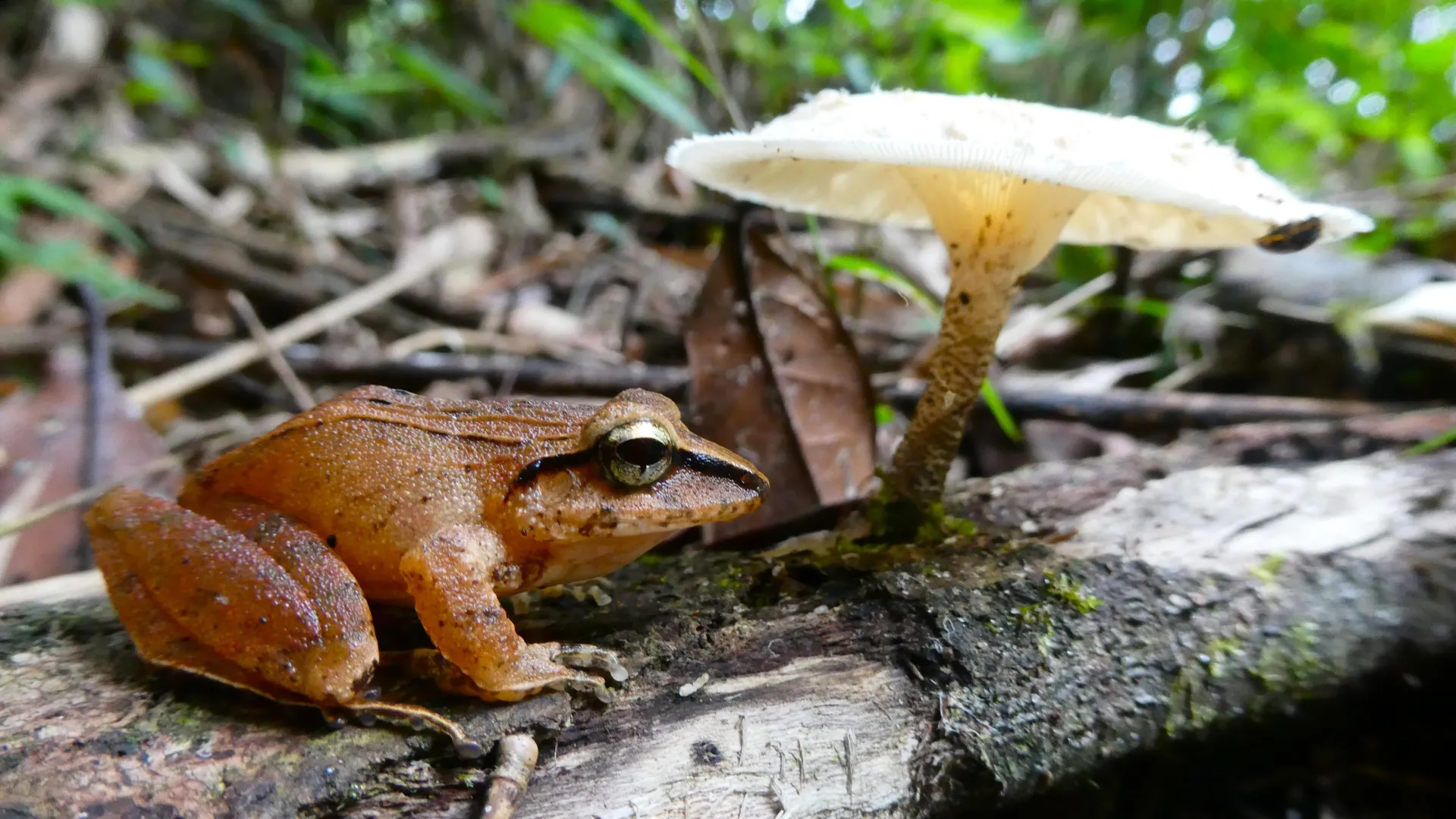
For nearly 50 years, scientists have struggled to explain why frogs began disappearing from Brazil's Atlantic Forest, one of the world's richest regions for amphibian diversity. Beginning in the 1970s, researchers documented dramatic population declines, but the cause of these losses remained uncertain. Now, scientists have uncovered compelling evidence pointing to a deadly fungal disease as the likely explanation.
The findings, published in Molecular Ecology, come from researchers at the Center for Conservation Genomics at the Smithsonian's National Zoo and Conservation Biology Institute (NZCBI) and Pennsylvania State University (PSU). The suspected culprit is chytridiomycosis, often called chytrid, a disease caused by the microscopic fungus Batrachochytrium dendrobatidis. Scientists believe the pathogen originated in Asia before spreading around the world during the 1970s and 1980s.
However, the fungus was not formally identified and described until 1999, long after devastating amphibian declines had begun. By then, hundreds of amphibian species worldwide had been driven toward extinction, and some had already disappeared. Because so many populations collapsed before scientists knew the fungus existed, determining whether it was responsible has been particularly difficult.
"After almost 50 years, we still aren't confident what caused many historical amphibian die-offs, making these declines some of the most enduring cold cases in wildlife epidemiology," said Jack Boyette, an NZCBI graduate fellow and doctoral candidate at PSU who led the research. A 50-Year-Old Mystery in Brazil's Atlantic Forest One of these longstanding mysteries centers on the Boracéia Biological Station in Brazil's Atlantic Forest, where amphibian populations experienced severe declines between 1979 and 1982. Some researchers previously suggested that climate change or unusually extreme weather might have triggered the disappearances.
The new findings, however, provide evidence that an emerging fungal disease was spreading through the area at precisely the same time. "While environmental factors could have played a role, our findings most directly implicate the chytrid fungus, revealing that regional invasion of the pathogen coincided with these unexplained amphibian disappearances," Boyette said. To investigate what happened, the researchers turned to an unexpected source of evidence: frogs preserved in museum collections decades earlier.
The Smithsonian's National Museum of Natural History houses specimens collected by William Ronald Heyer, a former curator of amphibians and reptiles. Heyer conducted five collecting expeditions at Boracéia, including two during the 1970s before the major population declines and three during the 1980s after the die-offs had occurred. These preserved animals offered scientists a rare opportunity to examine the period before and after the mysterious disappearances.
Extract — continue reading at the source.


