A symphony of insect songs rang through the Jurassic rainforest, and scientists have now found the traces of this ancient soundscape. Based on an analysis of fossilized katydid ancestors, the notes these insects played by strumming their wings can be reproduced, researchers report August 25 in the Proceedings of the National Academy of Sciences. This landscape of hills and grasslands was a hot, humid forest with giant ferns and ancient conifers during the Jurassic Period, 200 million to 145 million years ago.
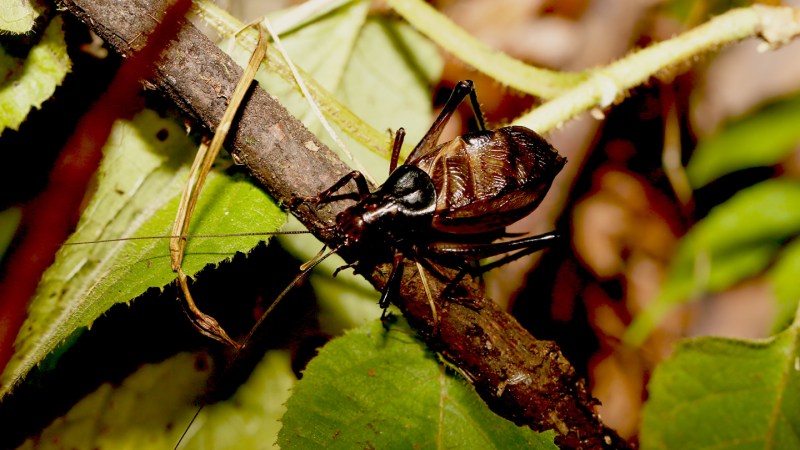
It hosted a stunning array of insects, Gu says, including ensiferans, the group that includes katydids, crickets and grigs. The fossils reveal the wing structures used to make mating calls. They’re like “nature’s violin,” says biophysicist Fernando Montealegre-Zapata, of the University of Lincoln in England.
One wing sports a row of microscopic teeth. As the wings close, a scraper on the other wing hits the teeth, making vibrations that are amplified by the rest of the wing. This forms what the team calls a syllable, the basic unit of sound.
The song emerges as the creatures rhythmically open and close their wings. For 20 fossils representing nine extinct species, the team simulated wing acoustics based on the teeth spacing, wing size and wings’ vibrating area. The researchers also used an evolutionary family tree to home in on each species’ call frequency, or its pitch.
They checked their process by reproducing the calls of living katydids, crickets and grigs based on photos of these insects’ wings. This confirmed that the measurements needed to figure out the animals’ sounds can be obtained from the kinds of 2-D images of wings made from photos of fossils. The cadence, or repetition, of those syllables isn’t clear from the fossils, Montealegre-Zapata says.
So the team looked to living ensiferans, whose repertoire is related to body shape and size and changes with temperature. The team trained a machine learning model with those characteristics and used the temperature of the Jurassic rainforest to simulate ancient insect calls. The result was a chorus of katydid ancestor calls.
Extract — continue reading at the source.