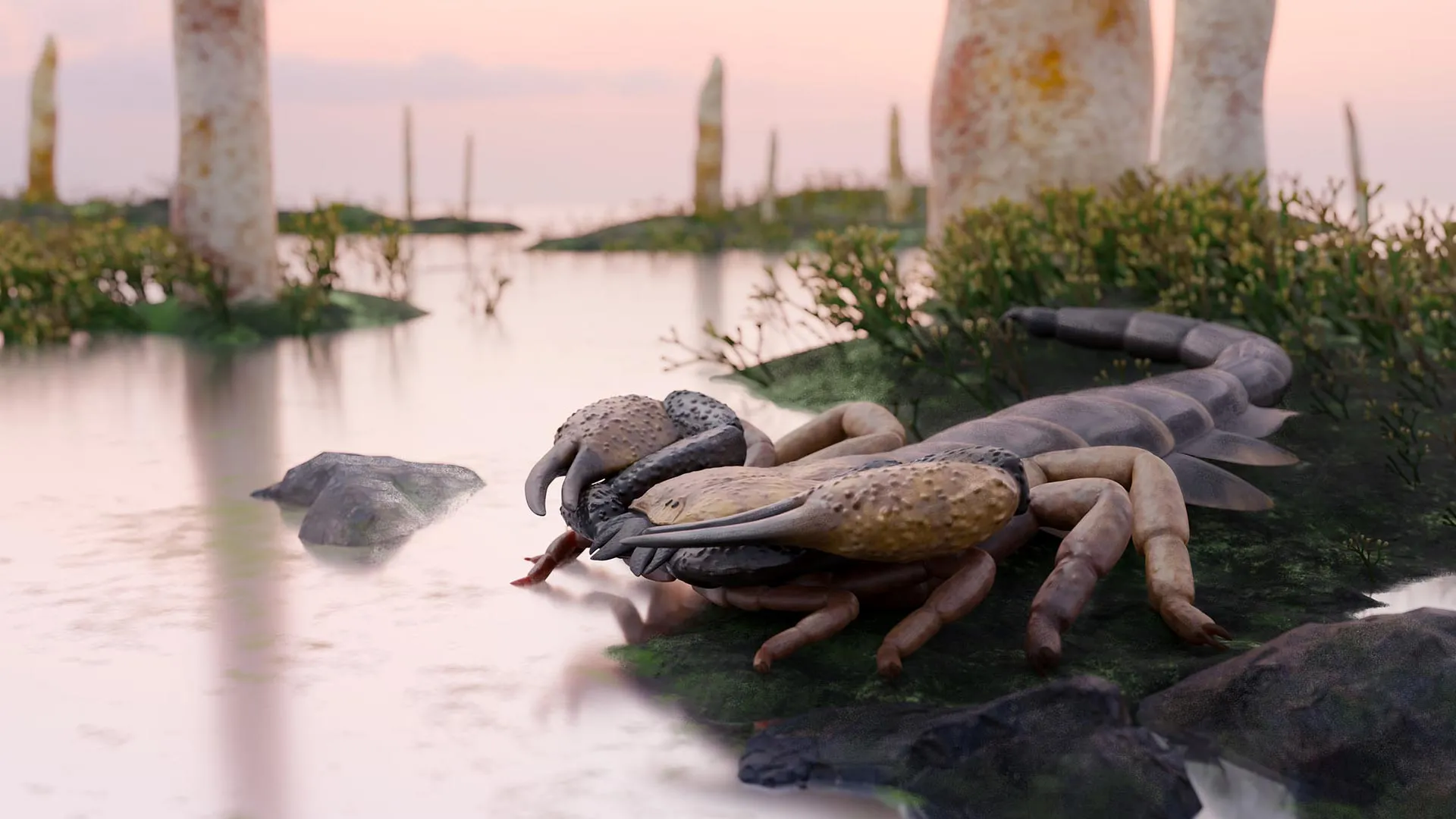
A newly analyzed fossil predator from what is now England and Wales has been identified as the largest scorpion known to science. Researchers from The University of Manchester and the Natural History Museum reached the conclusion after revisiting fossils that had remained in museum collections for more than 150 years. The animal, Praearcturus gigas, reached roughly one meter in length and carried pincers more than 16 centimeters long.
Around 415 million years ago, it would have been an imposing predator in the floodplain environments of the Early Devonian. A study published in Palaeontology used modern analytical methods and comparisons with more recently described fossil species to determine that Praearcturus was a scorpion and represented a distinct species. Howard, Curator of Fossil Arthropods at the Natural History Museum, London, and lead author of the study, said: "When we think of giant arthropods, people often picture Carboniferous rainforests with giant millipedes or dragonfly-like insects from later in Earth's history.
But Praearcturus lived at least 50 million years earlier, well before the evolution of trees, when life on land was only just getting started. "Confirming that this animal is a scorpion fundamentally changes our understanding of how and when these creatures evolved to such extraordinary sizes." The discovery pushes the story of giant arthropods much further back in time than the period usually associated with enormous insects and other invertebrates. Russell Garwood, Paleontologist at The University of Manchester, added: "Praearcturus has puzzled us paleontologists for more than a century.
By bringing together material from several collections and using cutting-edge imaging techniques, we've been able to build a clearer picture of the animal than was previously possible, which is really exciting. "What makes Praearcturus so interesting is that it became enormous at a time when life on land was otherwise very small. But it was a world that could somehow support a giant predator.
To try and better understand this ancient world, we compared the size of fossil scorpions with other animals alive at the time. To reach such extraordinary sizes, and conclude that perhaps it lived in water, where life was bigger." Praearcturus gigas lived during the Early Devonian, when terrestrial ecosystems were still in their infancy. Small plants and fungi had only recently begun spreading across the landscape, while forests and other complex land ecosystems had not yet developed.
That timing is important because Praearcturus lived before the high atmospheric oxygen levels associated with the later rise of forests. Those oxygen-rich conditions have often been linked to the enormous size of some later arthropods. Instead, the researchers suggest that ecological opportunity may help explain the animal's extraordinary size.
Extract — continue reading at the source.


