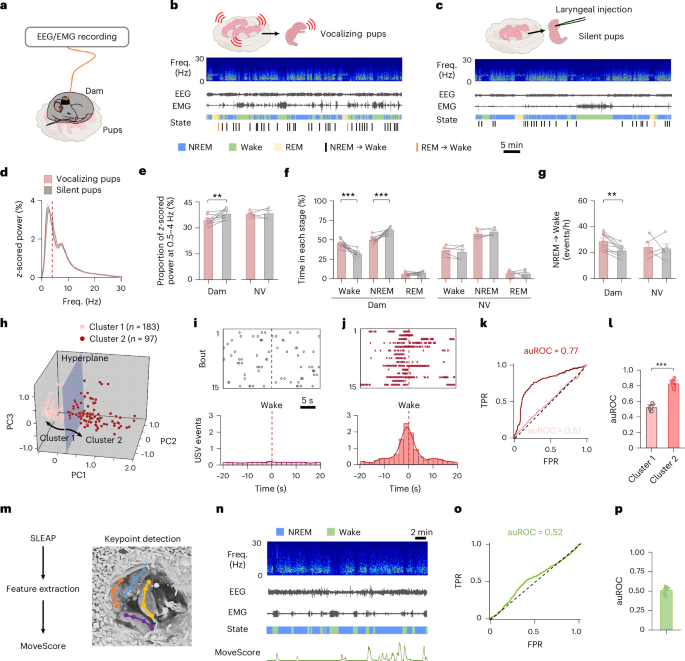
Maternal caregiving requires sensory vigilance to ensure offspring survival, particularly during sleep. Infant cries are salient sensory cues that reliably trigger maternal arousal and caregiving responses in both humans and dams, but the underlying neural circuitry remains poorly defined. Here we identify a corticohypothalamic circuit in mice that mediates maternal awakening in response to pup calls.
We show that layer 6 (L6) neurons in the temporal association cortex and ectorhinal cortex (TeA/Ect) projecting to the preoptic area (POA) exhibit enhanced responsiveness to pup calls after the transition to motherhood. This enhanced responsiveness is mediated by increased expression of dopamine receptor D1 (Drd1) in TeA/Ect → POA neurons. Additionally, we reveal a pathway from the auditory thalamus to L6 TeA/Ect neurons that transmits pup cues during sleep.
Together, these findings identify a dedicated neural circuit that grants infant cries privileged access to arousal systems, likely representing a fundamental adaptation for caregiving across mammals. This is a preview of subscription content, access via your institution Access Nature and 54 other Nature Portfolio journals Get Nature+, our best-value online-access subscription Receive 12 print issues and online access Prices may be subject to local taxes which are calculated during checkout All data necessary to understand the conclusions of this study are available in the paper. Source data are provided with this paper.
All custom code used to calculate MoveScore and the USV Complexity Index, perform PCA and classify sleep−wake states is available on GitHub (https://github.com/TANGPW22/Maternal-awakening-code.git). The signal functions of early infant crying. Brain Sci. 27, 443–458, discussion 459−490 (2004).
Ultrasounds and maternal behavior in small rodents. Psychobiol. 5, 371–387 https://doi.org/10.1002/dev.420050410 (1972). Infant rodent ultrasounds − a gate to the understanding of sound communication.
Genet. 35, 19–29 https://doi.org/10.1007/s10519-004-0853-8 (2005). T., Kotrba, R., Teichroeb, L. A review of infant distress vocalizations.
Extract — continue reading at the source.