John Last is a freelance journalist and former foreign correspondent living outside Ottawa, Canada. Across Europe, young people are being arrested in their thousands. In Milan, jackbooted soldiers from the Italian military — average age, 38 — haul protesters, some of whom are as young as 12 and 13, away from picket lines and into armored vehicles.
Italy’s government — average age, 60 — has passed a new decree allowing detainments for up to 24 hours without charge. Vandals can now be arrested 48 hours after their crimes; Deputy Prime Minister Matteo Salvini, 53, has called for their parents to face financial penalties too. Italy’s weekend of protests at the end of October, in at least a dozen major cities, was the most destructive in recent memory.
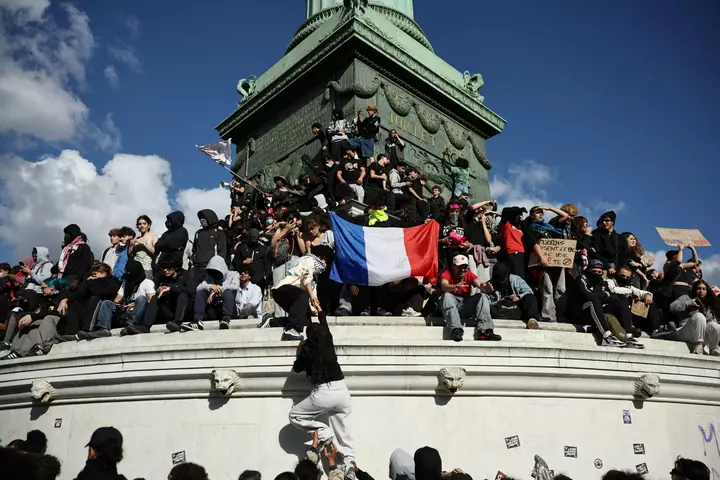
In Milan, hooded youths looted the city’s luxury stores, pilfering products, one reporter wrote, “that they cannot afford and may never be able to buy.” But as shocking as Italy’s protests have been, they pale in comparison to those in France. Mobs of people have paralyzed city centers across the country for weeks. The grand streets of Paris have been blanketed in acrid smoke.
French President Emmanuel Macron has accused an alliance of “radical far-left groups [and] criminals” of trying “to bring down the Republic.” Fifty-three police officers were injured over the course of a single weekend. After more than a month, it is almost hard to believe that protests of this magnitude began over the failures of a university application portal. But by now, the grievances have multiplied: the high cost of fuel, the crowding of schools, the inaccessibility of housing, the growing precarity of work.
In turn, the protests have taken on an existential desperation. An unmistakable vibe of despair permeates the masked protesters. They take our money, they tax us a lot and we can’t say anything,” one protester in Paris told the BBC.
While young people reel from crisis to crisis — wars, economic stagnation, climate disaster, a pandemic — they cash in. Rising prices, precarious work, broken schools: As a generation, the boomers have remained largely unaffected while the value of their real estate and investments boomed. As their wealth and number grew, they came to set the agendas of unions, politicians and the media, and they bent the state to suppress any who would rally against them.
Extract — continue reading at the source.