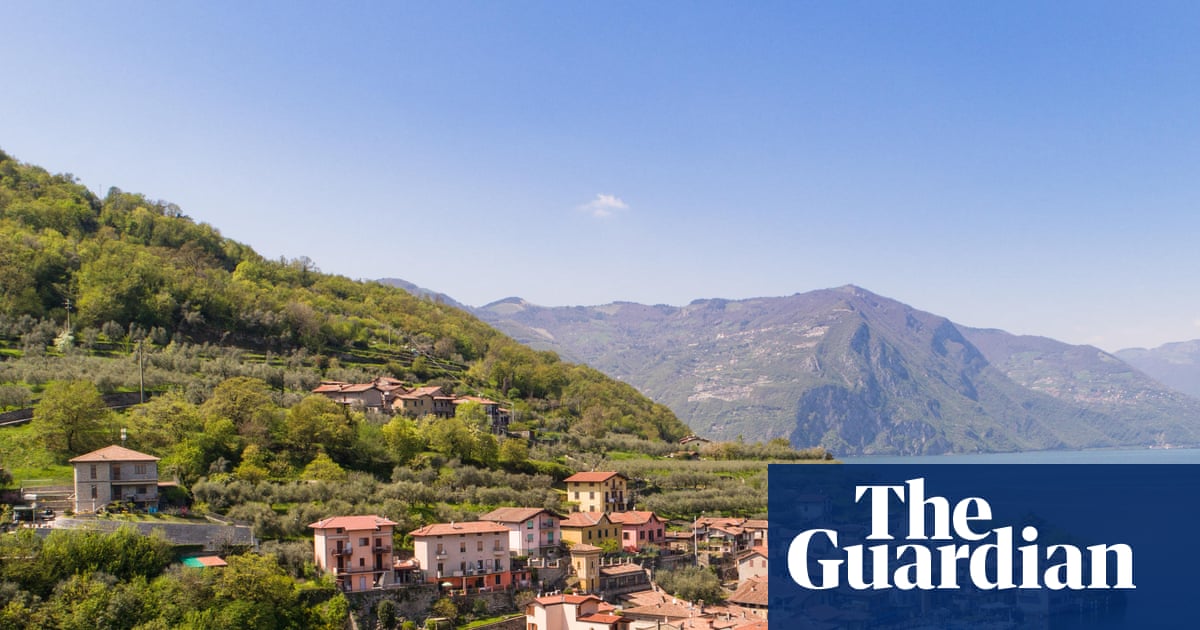
Rust red and burnt sienna speckle the green mountain rising from Lake Iseo. Golden autumn sunlight shimmers on the water. Monte Isola, Italy’s largest lake island, is a peak of sheer cliffs and dense forest, dotted with old fishing hamlets and hillside villages, each as pretty as the terraced villas of Lake Como and Garda, but with far fewer visitors.
I arrive at the small port town of Peschiera Maraglio – where striped wooden boats jut from the water like the gondolas of Venice – on a ferry from Sulzano, a five-minute hop across the water. Residents can zip up and down the steep island roads on mopeds, and a small fleet of van-sized buses trundle around throughout the day, but nearly all cars are forbidden and visitors have to explore on foot or bike. Even bikes are banned from boats at the weekend.
Not that it matters: the harbour front is lined with bike rentals (from €4 an hour for a standard bike). I’m normally a nervous cyclist, but car-free roads raise my confidence. Plus, most other visitors have the telltale front-wheel wobble of novice riders.
This isn’t the place for Lycra and personal bests; the smooth-as-silk, quiet roads are for slow pedalling, and neck swivelling to take in another gorgeous view of Lake Iseo. The circular lakeside route winds past olive groves tumbling to the shore. I thought I’d need base layers and gloves this far into autumn, but I’m in shorts and a T-shirt and already working up a sweat in 24C sunshine.
I pedal through the lakeside hamlet of Sensole in the island’s south-west and stop in Menzino, just along the shore. There’s a cafe-bar catering to cyclists, so I fuel up with an espresso con lake view. The view from the western side of the island is somewhat marred by a huge concrete factory on the mainland, so I keep my head down on the pedal to Siviano, the island’s capital.
The shambling streets are sleepy; the stacked skyline of orange, lemon and magnolia villas is punctuated by the looming facade of Santi Faustino e Giovita church and a medieval stone tower. Monte Isola has been inhabited since the Roman era. Venetian rule in the 15th and 16th centuries left the main towns resembling those on Garda and Como: hillside terraces of wooden-shuttered pastel villas.
Extract — continue reading at the source.