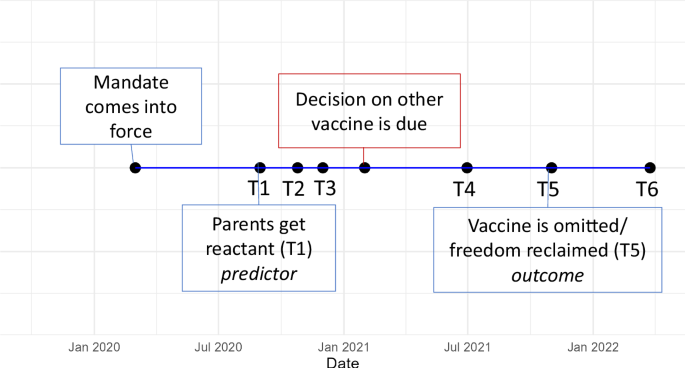
Vaccine mandates can increase uptake, yet their psychological effects remain underexplored. Psychological reactance theory suggests that mandates may prompt resistance and reduce acceptance of voluntary vaccination. We examined changes in reactance and attitudes toward the measles vaccine mandate introduced in Germany in 2020, the extent to which reactance is associated with attempts at freedom restoration (i.e. subsequent voluntary vaccine uptake), and the role of trust in mandate acceptance.
We conducted a preregistered longitudinal online survey with an initial sample of 6901 respondents, followed across six time points over 20 months (Aug 2020 – Mar 2022). The sample included parents affected by the mandate and adults without children as a comparison group. We used multilevel modelling to examine the temporal development of reactance, group differences between those affected and not affected, and trust as a determinant.
Logistic regression analysis was used to assess whether levels of reactance were associated with uptake of a voluntary vaccine at a later time point. Data show that reactance levels are low but stable over time, while attitudes toward the mandate become increasingly negative (β = -0·01, 95% CI [-0·02, -0·01]). Higher trust is associated with lower reactance (β = -0·28, 95% CI [-0·30, -0·26]) and more positive attitudes (β = 0·43, 95% CI [0·41, 0·45]).
Importantly, higher initial reactance predicts a lower likelihood of later uptake of voluntary vaccines (OR = 0.49, 95% CI [0·34, 0·68]). These findings suggest that reactance to public health policies may persist rather than fade and may shape downstream health behaviour. Building trust and ensuring effective enforcement may help legitimise mandates and mitigate opposition.
Though significant progress has been made worldwide toward the elimination of measles, recent years have brought continued challenges. In 2024, the European Region reported 130,000 measles cases—the highest number in over 25 years1. Despite the fact that vaccines are available, uptake remains suboptimal in many countries.
Germany responded to these challenges by introducing a measles vaccine mandate in March 20202, notably coinciding with the onset of the COVID-19 pandemic. Among those affected were children in childcare and schools, who were required to provide proof of measles immunity. If not, sanctions such as removal from childcare or fines of up to 2500 euros could be imposed.
Extract — continue reading at the source.