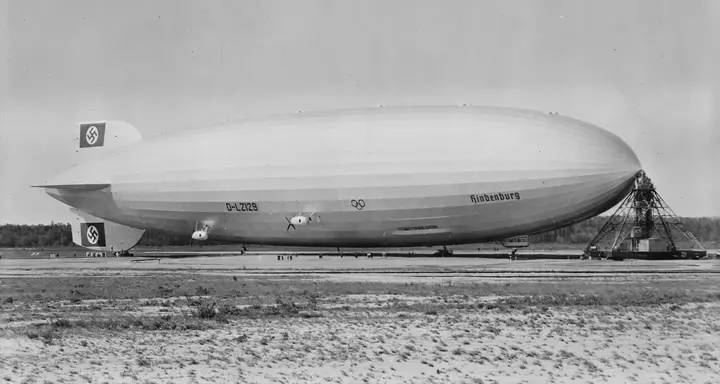
Ernst Lehmann had transported some interesting creatures in his time as a zeppelin captain—prize Trakehner horses from Prussia; gorillas, chimpanzees, and monkeys used in scientific research; guinea pigs; canaries; carrier pigeons; even queen bees—but perhaps the species that made itself the biggest nuisance for the crew was dogs. Dogs always seemed to come along with American entertainer owners who were apparently unable to travel without them. The year before, the silent film actor Douglas Fairbanks, star of swashbuckling hits like The Mark of Zorro, Robin Hood, and The Three Musketeers, was traveling home from Europe with his new bride, the former Lady Sylvia Ashley, and their six-month‑old Scottie named Bobby Burns.
Fairbanks had allowed little Bobby Burns off his leash so he could avail himself of the facilities. As the first animal aboard the new airship, he decided to mark his territory, leaving, as steward Wilhelm Balla quipped, his “business cards everywhere” while Mrs. Fairbanks worked on a jigsaw puzzle.
Passengers’ casual disregard for the sheer wonder of flight, or just how quickly they became bored and defaulted to their mindless earthly activities, never ceased to amaze Lehmann. On the Graf Zeppelin’s very first flight over Germany in 1928, he had passed through the dining room and found two passengers who had already grown tired of looking out the window and were instead sitting quietly playing a game of chess. Man had dreamed of flying for centuries.
Lehmann’s was a complaint shared by many groundbreaking aviators, of the heavier‑ and lighter‑than‑air varieties alike. Even Charles Lindbergh agreed. The rivalry between airships and airplanes aside, the brotherhood of aviators had witnessed some remarkable sights in the first three decades of the twentieth century.
Only an airman knew that when flying over London, the lights along the Thames looked like the Milky Way, and only from an aircraft could the “benumbing” and “monstrous” vastness of the swamps, forests, and streams of Siberia be appreciated in their endless expanse. So uncharted was their route on the round‑the‑world flight that when planning their journey over the Stanovoy mountains in the Russian Far East, the crew could find almost no information about the height of the range aside from one report that suggested the section in question was 3,500 feet high. As a precaution, Eckener added an extra 2,000 feet of clearance as they groped their way through fog and clouds.
Just before they reached the Sea of Okhotsk, the clouds finally dispersed, and only then did the crew realize they had cleared the mountain ridge by a mere three hundred feet. After Siberia’s wild, hostile nature, it was a “refreshing” relief when they reached the island of Hokkaido the next morning and could look down to see “neatly divided…rice fields, gardens, and clean houses.” On a zeppelin, as a DZR marketing pamphlet exclaimed, “the prophetic vision of Jules Verne has been realized.” Passengers could experience for themselves the stuff of science fiction novels. In describing this balance between wonder and commerce, DZR might have done a bit too much to convince nervous fliers that riding on a zeppelin was as easy as sitting in their own living rooms.
Extract — continue reading at the source.