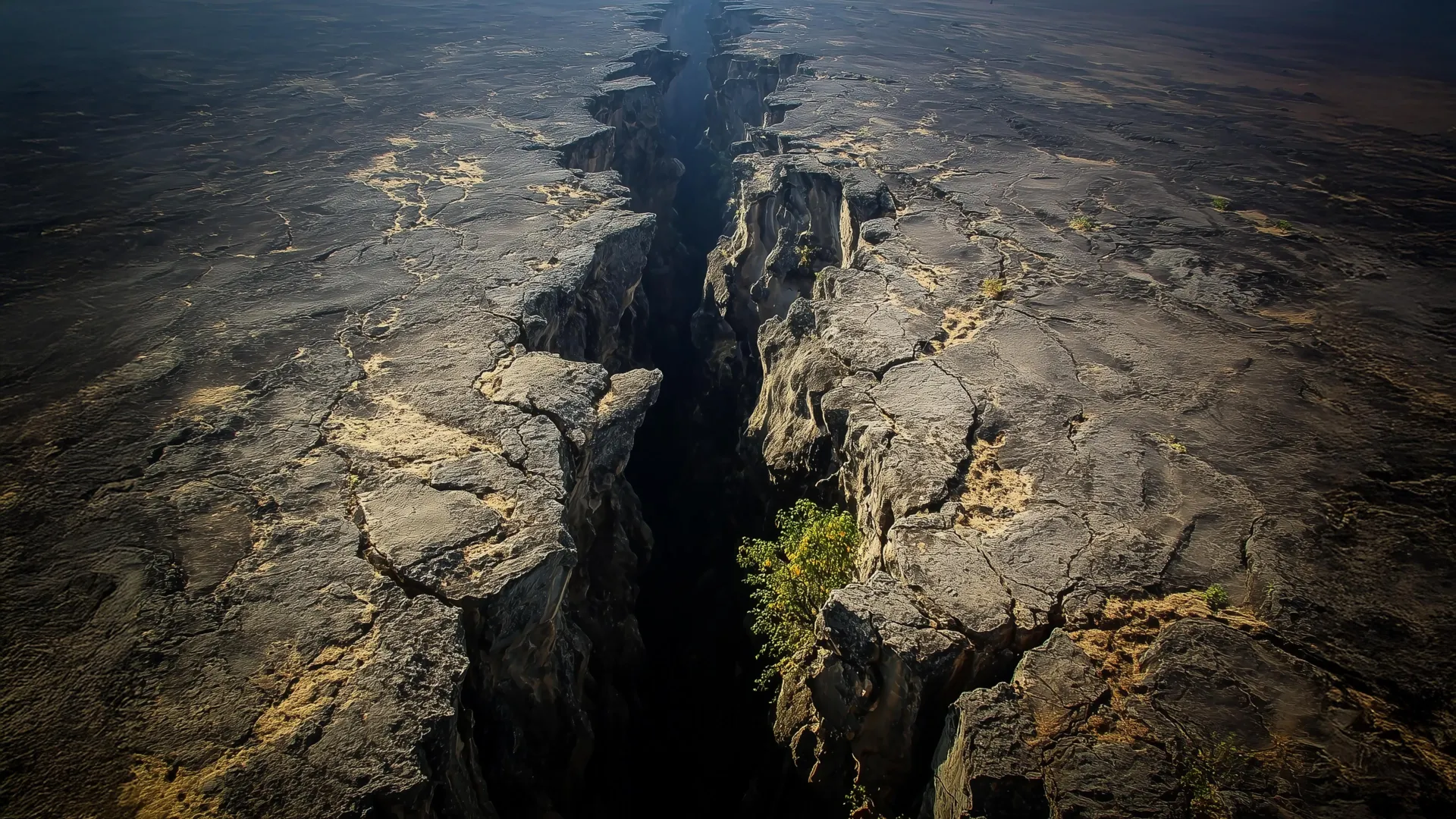
Computer models are helping scientists explain a puzzling pattern of deformation beneath the East African Rift System. The results point to the African Superplume, a vast upwelling of hot mantle material deep inside Earth, as the source of unusual motion that runs parallel to the rift as well as a matching pattern in the way seismic waves travel through the rocks below. Continental rifting happens when Earth's rigid outer shell begins to stretch and thin.
That outer shell, called the lithosphere, includes the crust and the uppermost part of the mantle. As the lithosphere is pulled apart, it can behave differently depending on how quickly and where the stress is applied. Near the surface, rocks can fracture, producing faults and earthquakes.
Deeper down, hotter material can deform more gradually. Sarah Stamps compares those different behaviors to Silly Putty. "If you hit Silly Putty with a hammer, it can actually crack and break," said Stamps, associate professor in the Department of Geosciences, part of the Virginia Tech College of Science.
"But if you slowly pull it apart, the Silly Putty stretches. So on different time scales, Earth's lithosphere behaves in different ways." In most continental rifts, deformation follows a relatively predictable pattern. The strongest movement generally occurs perpendicular to the rift, in the direction the crust is being pulled apart.
The East African Rift System, the largest continental rift system on Earth, does show that expected rift perpendicular deformation. But Stamps found something else after more than 12 years of GPS measurements. Parts of the region were also deforming in a direction parallel to the rift itself.
That unexpected motion became a central mystery for her team at the Geodesy and Tectonophysics Lab. In a study published in the Journal of Geophysical Research, the researchers used 3D thermomechanical models to investigate what could be producing the unusual deformation. The modeling was developed by first author Tahiry Rajaonarison, a postdoctoral researcher at New Mexico Tech who earned his Ph.D. at Virginia Tech while working in Stamps's lab.
Extract — continue reading at the source.