Sentiment analysis captures overall opinion polarity, but it often fails to reveal the key emotions that drive consumer behavior. The recognition of both sentiment and emotions provides crucial information to uncover underlying drivers of consumers behavior and brand loyalty. These important insights enable businesses to detect emerging issues, refine products and services, and personalize consumer experiences.
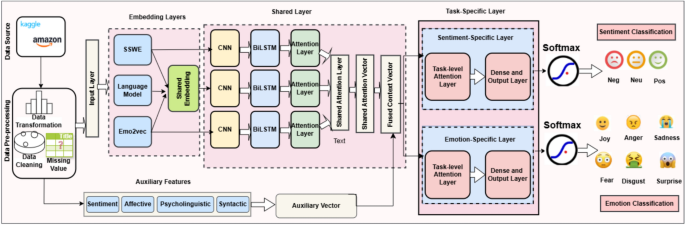
This study proposes a multi-task approach that performs sentiment classification and emotion detection tasks based on consumer reviews and corresponding ratings. To this end, we propose Consumer Sentiment and Emotion Modeling (COSMO-MT), a deep learning-based multi-task model for sentiment classification and emotion detection. It begins with an input layer followed by embedding layers that provide sentiment-specific, emotion-specific, and shared embeddings from the input text.
Each embedding is processed through shared layers consisting of CNN, BiLSTM, and attention mechanisms. Moreover, several auxiliary features are incorporated into the shared layers to provide explicit linguistic information. The outputs of the shared layers are then passed to task-specific layers for sentiment classification and emotion detection.
Finally, corresponding dense and output layers generate predictions for both tasks. We evaluate the efficacy of the proposed COSMO-MT model on two publicly available datasets. It significantly outperforms existing studies and baseline methods.
Over the last two decades, social media has evolved into one of the most efficient sources of communication. Social networking and e-commerce platforms, such as Facebook, Twitter, Instagram, Yelp, and Amazon provide consumers with platforms to share their experiences, opinions, and emotions about products and services. This digital transformation has resulted in large volumes of user-generated content (UGC)1.
Recent advancements in intelligent deep learning (DL) frameworks across diverse domains, including predictive analytics, healthcare modelling, and hate speech detection further motivate the development of robust AI-driven approaches for analyzing consumer-centric textual data2. Consequently, consumers tend to make purchasing decisions based on the informative UGC, including product reviews, ratings, and features. The accessibility of this information has led to significant changes in consumers behavior and decision-making via transparency and actionable insights.
Extract — continue reading at the source.