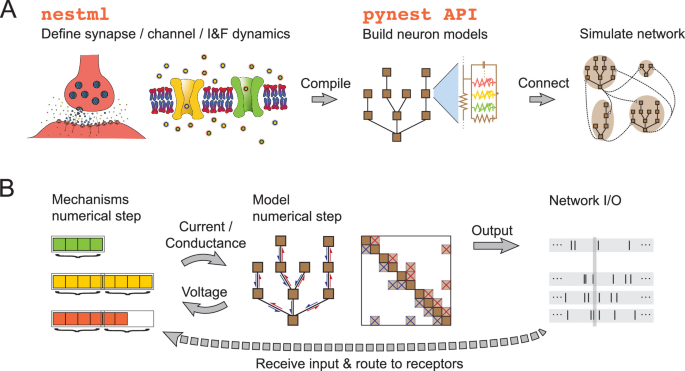
While subcellular mechanisms in the dendrites of neurons govern the implementation of learning and memory in the brain, large-scale network simulations featuring such processes remain challenging to achieve. This can be attributed to a lack of appropriate software tools, as neuroscientific simulators focus on the one hand on highly detailed models, and on the other hand on massive networks featuring point neurons. Here, we fill this gap by implementing a framework for the massively parallel simulation of simplified dendrite models with customizable subcellular dynamics.
We leverage the NEural Simulation Tool (NEST), the neuroscientific reference with respect to efficient massively parallel simulations of point-neuron networks. By co-opting the model description language NESTML, we generate C++ code implementing user-configurable subcellular dynamics. We show that the generated models run efficiently, leading to scalable NEST network simulations.
To showcase relevant functionalities, we provide a proof-of-concept demonstration that a key sensory computation – the association of top-down context arriving at distal dendrites in layer 1 and feedforward sensory input arriving perisomatically – can be achieved in a single-shot fashion through apical calcium dynamics. Our work thus unlocks the study of how dendritic processes shape network function and learning at scale. The brain computes in a massively parallel fashion.
In the human brain, 86 billion neurons1 continuously convert synaptic inputs into action potential (AP) output signals. Moreover, even at the subcellular level, computations proceed in a massively parallel fashion. Approximately 150 trillion synapses2 (up to ~10,000 per neuron) are supported by complex molecular signaling networks within dendritic compartments.
In itself, these signaling networks can also be understood as nanoscale computations that convert synaptic input, backpropagating APs, and local voltage and concentration signals into weight dynamics that support learning and memory3. Furthermore, the recent, explosive growth of AI technologies has shown the importance of scale4, as it was achieved in large part by applying a well-known attentional motif5 at massive scales6,7,8. Similarly, it can be expected that understanding the computational significance of subcellular processes will require embedding them in large-scale network simulations.
It is only natural, thus, to use the parallelization and vectorization capabilities of modern supercomputing architectures to simulate the brain at scale in a massively parallel fashion. Simulation of subcellular processes in biophysically detailed models has long been implemented in the successful NEURON simulator9,10, which is the most widely used tool for investigating models of individual neurons in great detail. Although NEURON admits efficient parallel simulations of network models through CoreNEURON10, users have to take care of the parallel distribution of neurons across MPI processes themselves11.
Extract — continue reading at the source.


