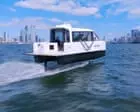
Cutting through New York Harbor in the shadow of the Statue of Liberty, the small white boat we were riding on caught the attention of passengers aboard a nearby sightseeing ferry. His company builds fully electric hydrofoil boats. These vessels use underwater “wings” to lift their hulls above the surface as they pick up speed.
By raising the boat out of the water, the design dramatically reduces drag, one of the biggest obstacles to making boats more energy-efficient. We’re going for a takeoff,” Laakmann said as the boat rapidly accelerated. The hydrofoils lifted the hull about a foot and a half above the water.
Almost immediately, the ride transformed. The familiar slap of the boat pushing through waves became a smooth, almost airborne glide. The hydrofoil effect is more than a novelty.
Water creates significant resistance, and overcoming it takes energy. Electrifying boats is a challenge because batteries are heavy, and that extra weight increases the power needed to move the vessel. Hydrofoils may offer a solution.
By lifting much of the hull out of the water, they reduce drag, allowing a vessel to move more efficiently. Vessev says its hydrofoil design cuts drag by about 66%. That greater efficiency allows the boats to carry smaller battery packs, reducing both weight and cost.
But efficiency is only part of the equation. Making a boat electric is not simply a matter of replacing a diesel engine with a motor and battery. Operators must also consider how far a vessel needs to travel, how many passengers it carries, how quickly it must recharge, and how much weight it can accommodate.
Extract — continue reading at the source.