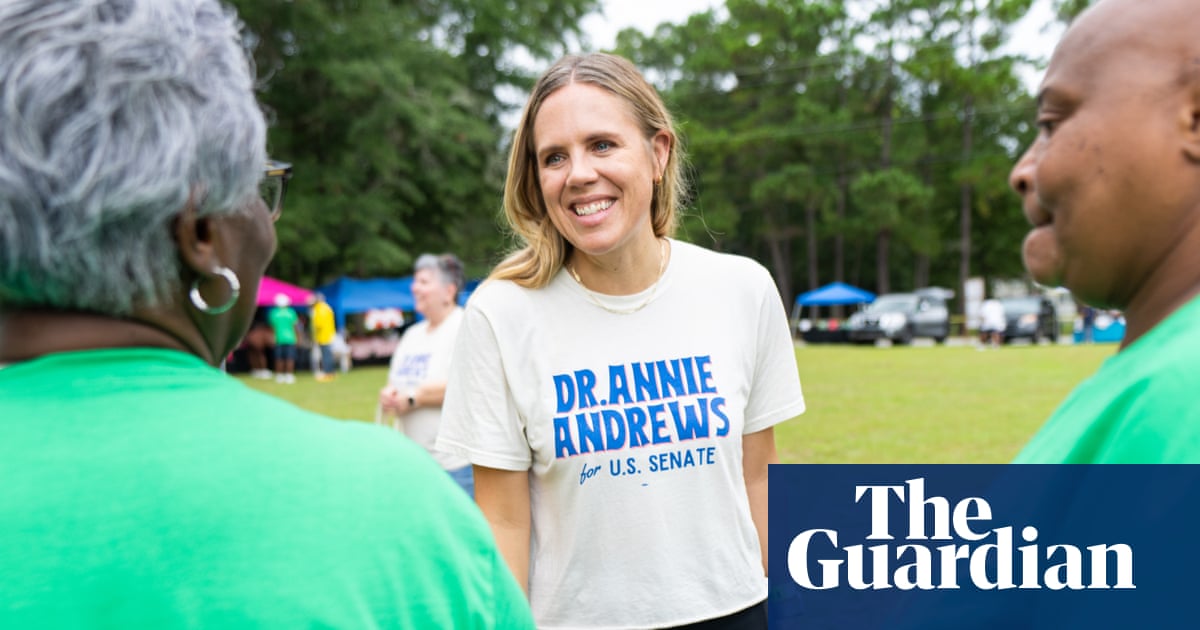
Annie Andrews was a dark horse Democrat challenging a five-term Republican in the US Senate when 314 Action, a political action fund devoted to electing scientists and doctors, first backed her. Now, after the unexpected death of Senator Lindsey Graham, Andrews finds herself in a closely watched race. Donald Trump persuaded South Carolina voters last week to select Graham’s sister, Darline, as the new Republican candidate.
They will face off in November in an election still heavily favored to remain in Republican hands in the conservative state. Andrews, a pediatrician for 20 years, has made public health and science a central part of her campaign, highlighting the importance of vaccines as measles spread through South Carolina – and so have the other candidates supported by 314 Action. Last year, 314 laid out an ambitious goal: elect at least 100 doctors to state and federal office by 2030.
The group had an initial fundraising target of $25m, which it reached in August, to help establish Democratic doctors in state legislatures, governorships, and federal offices – “building that pipeline of talent to higher office”, said Shaughnessy Naughton, president of 314 Action. Headlines in 2026 have been dominated by outbreaks of infectious diseases and foodborne illnesses, the biggest cuts to Medicaid in its history, the gutting of scientific research, immigration raids in hospitals, and more, making health and science salient issues in the US midterm elections. Doctors and experts are “on the frontlines of this”, Andrews said.
But only about 12% of the candidates won, according to research by Matthew Motta, assistant professor at Boston University’s School of Public Health. Endorsement and financial support from 314 Action do increase the likelihood that Stem candidates will win, according to his research. But the goal of 100 wins in the next four years is ambitious, Motta said.
In fact, candidates with Stem backgrounds were less likely to win than non-Stem peers in 2018, according to an analysis coauthored by Meredith Conroy, political science professor at California State University, San Bernardino. They probably didn’t lose because of their science background, Conroy said, adding: “I just don’t think it was a salient enough identity at the time to suggest it made or broke their campaign.” But recent events are changing that, making health and science a top-of-mind concern for voters, Conroy and Motta pointed out. State-level leadership on health will also be key as national health agencies falter and as states consider restrictive laws on issues like vaccination and reproductive health, Motta said.
Josh Green, the governor of Hawaii and an emergency physician, is the only doctor-governor in the United States right now. But he wants to feel less alone. He is mentoring candidates through 314 on how to engage with constituents and “how to message in a way that political people have to master”.
Extract — continue reading at the source.