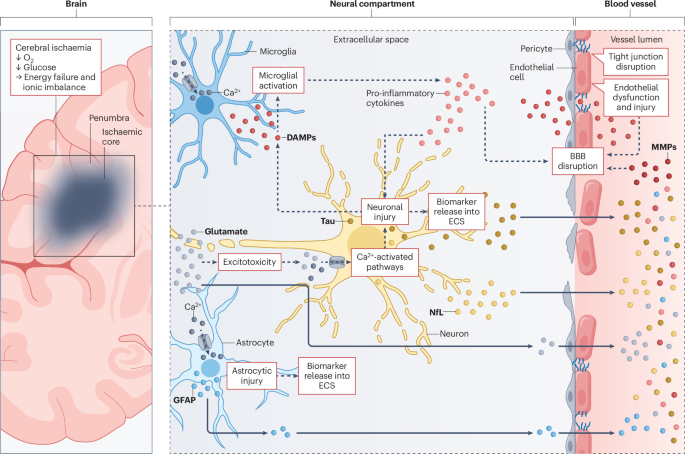
Acute ischaemic stroke remains a leading cause of death and disability worldwide, and even highly effective reperfusion therapies benefit only a fraction of patients. Current clinical decision-making relies largely on clinical examination and imaging, which provide limited insight into the molecular mechanisms that drive injury progression, treatment response and recovery. Molecular biomarkers offer a complementary window into this biology: they can resolve pathway activity at the cellular level, detect pre-morphological tissue stress, report on multi-organ processes and enable high-frequency, minimally invasive monitoring.
Here we synthesize emerging evidence across selected, interconnected, outcome-relevant pathomechanisms of acute ischaemic stroke, spanning ischaemic brain injury, metabolism, systemic inflammation and gut dysbiosis. We highlight promising biomarker candidates including brain-derived tau, neurofilament light chain, metabolic and inflammatory signatures and microbiota-derived metabolites and argue that substantial further work is required. In particular, we emphasize the need to prioritize biomarkers as tools for elucidating human stroke pathophysiology rather than focusing solely on therapeutic targets.
To guide this effort, we propose a pragmatic, six-phase roadmap from discovery to clinical implementation that emphasizes context of use, assay development, clinical validation and biomarker-guided trials. Applied systematically, mechanism-informed biomarkers could enable more precise, biology-guided stroke care and help to close the translational gap. Acute ischaemic stroke care still relies largely on clinical scores and imaging, which incompletely capture evolving molecular mechanisms of brain injury, metabolism, inflammation and gut dysbiosis.
Circulating molecular biomarkers can resolve active pathophysiological pathways, detect pre-morphological tissue stress and allow high-frequency, low-burden monitoring of cerebral and systemic responses across the hyperacute, acute and subacute phases. Validated neuronal injury markers such as brain-derived tau and neurofilament light chain demonstrate that dynamic quantification of ischaemic brain injury and treatment effects in blood is feasible in humans. Mechanism-specific biomarkers of ischaemic brain injury, metabolism, systemic inflammation and gut dysbiosis could enable biologically coherent patient stratification, time and pathway-guided interventions and more efficient neuroprotective and rehabilitation trials.
A structured multi-phase roadmap, from defining context of use to randomized biomarker-guided care, provides a framework for generating the analytical, biological and clinical evidence required for implementation. Coordinated efforts involving deeply phenotyped longitudinal cohorts, omics-driven discovery, biomarker-focused experimental work, systematic biosampling in clinical trials and academic–industry–regulator collaboration are essential for translating molecular biomarkers into routine stroke care. This is a preview of subscription content, access via your institution Access Nature and 54 other Nature Portfolio journals Get Nature+, our best-value online-access subscription Receive 12 print issues and online access Prices may be subject to local taxes which are calculated during checkout Vollset, S. et al.
Burden of disease scenarios for 204 countries and territories, 2022-2050: a forecasting analysis for the Global Burden of Disease Study 2021. Lancet 403, 2204–2256 https://doi.org/10.1016/S0140-6736(24)00685-8 (2024). Pragmatic solutions to reduce the global burden of stroke: a World Stroke Organization–Lancet Neurology Commission.
Extract — continue reading at the source.


