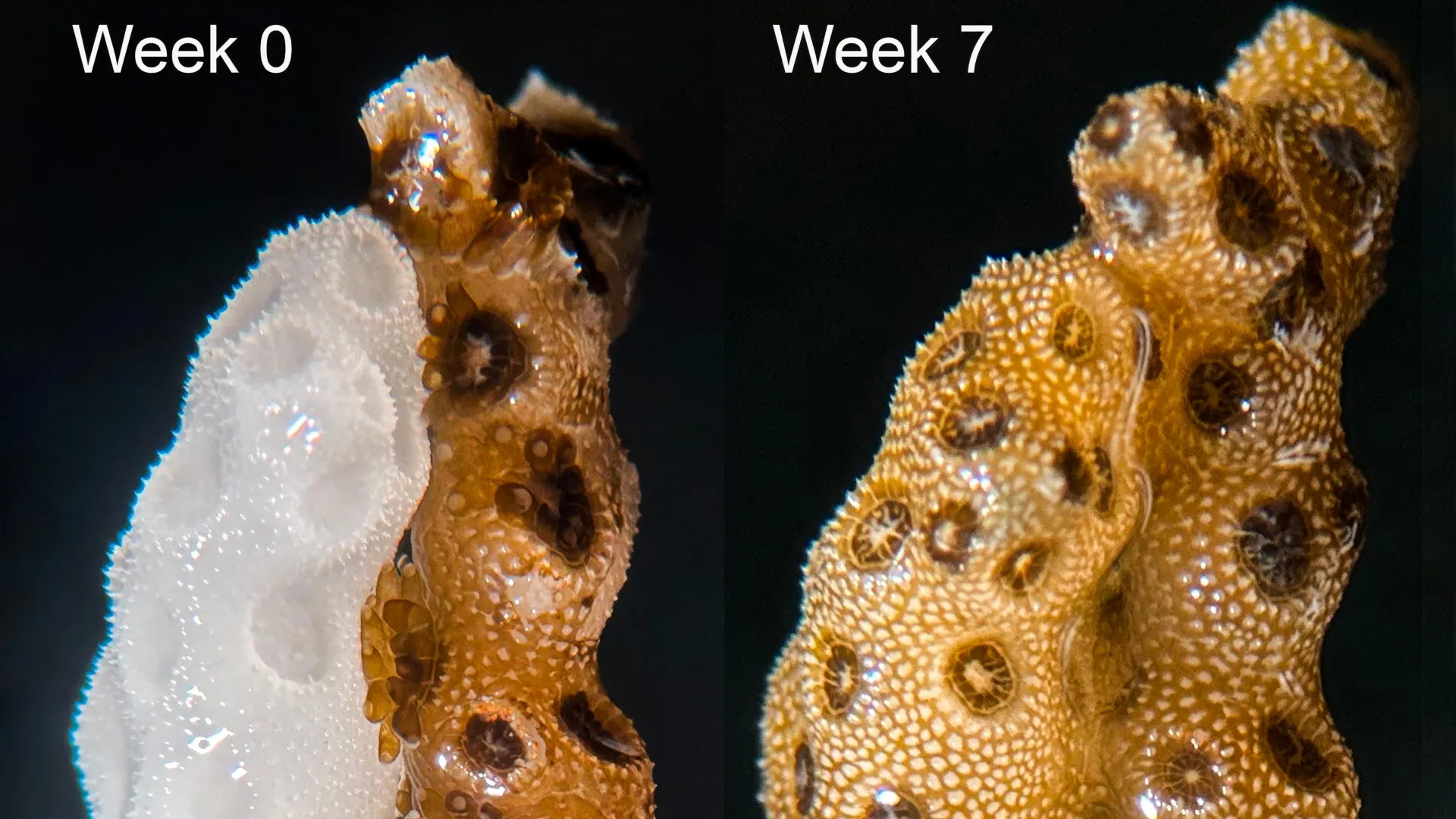
For the first time, researchers have demonstrated that severely bleached corals can fully recover after spending just a few days in contact with healthy, genetically identical corals. In laboratory experiments, corals that had turned white and were close to dying regained their health within seven weeks. According to a study published on October 14 in Science Advances, this represents the fastest documented recovery from coral bleaching.
The discovery could lead to new techniques for restoring coral reefs, which some estimates suggest could disappear within decades as climate change fuels increasingly severe and frequent marine heat waves. Coral bleaching occurs when rising ocean temperatures cause corals to lose the beneficial algae living inside their tissues. These algae supply much of the energy corals depend on for growth and survival.
Without them, corals lose their vibrant colors, struggle to obtain enough nourishment, and become more susceptible to harmful algae. Even when they survive, regaining their health can take months or years. "While bleached corals may be dying, they are not dead yet," said lead author Danny Collins, an oceans PhD student at the Stanford Doerr School of Sustainability.
"The question we wanted to answer is, once a coral has bleached, what can we do?" An Unexpected Discovery Reveals a Way to Rescue Dying Corals Although they may resemble plants or rocks, corals are animals. In most coral species, individual animals reproduce by creating genetically identical copies of themselves. These clones grow together into large colonies that form the foundation of coral reefs.
The idea for the study emerged from an unexpected observation in 2025. Steve Palumbi, a study coauthor and the Jane and Marshall Steel, Jr. Professor in Marine Sciences, noticed something unusual in his laboratory.
Two fragments taken from the same coral colony, one healthy and the other bleached, had fallen against each other in an aquarium. Where the fragments touched, the bleached coral began regaining its color. The change suggested that beneficial algae were returning to its tissues.
Extract — continue reading at the source.


