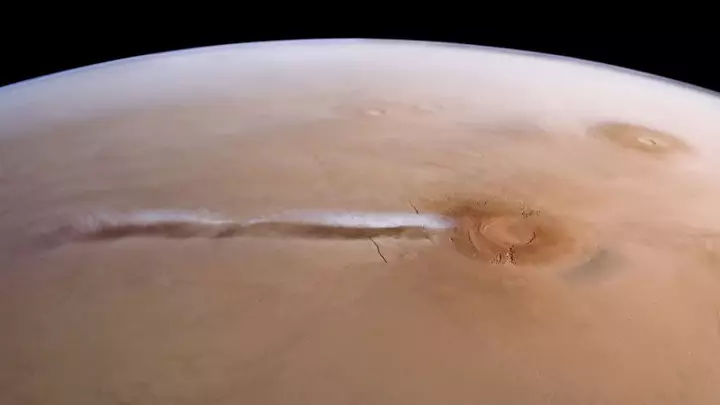
One of Mars’ strangest clouds may rely on unusual physics to emerge. The Red Planet’s ribbonlike cloud — which stretches as long as four Grand Canyons laid end-to-end — may form without a speck of starting material to seed it, researchers report October 7 in Nature Geoscience. This manner of forming clouds, called homogenous nucleation, was thought to be possible on paper but not to occur naturally.
Tiny particles such as dust or salt floating in the air seed typical clouds on Earth. But that cloud physics doesn’t seem to apply to the Arsia Mons Elongated Cloud. Beyond its impressive length, this wisp of water ice is remarkably consistent, forming daily in the same spot roughly 45 kilometers high on the slope of a Martian volcano for several months each year.
The team tried and tried but couldn’t reproduce the cloud’s formation, including its lengthy tail and consistent cycle, with computer models employing standard cloud physics, says François Forget, an astrophysicist at the Laboratoire de Météorologie Dynamique, or LMD, in Paris. There’s no shortage of dust on Mars. The trouble is that high up in a thin Martian atmosphere, few cloud-forming dust particles stay suspended.
Instead, they probably clump together and eventually fall, says planetary physicist Jorge Hernández-Bernal, who did the work at LMD. This left cloud formation without seeds as the most convincing explanation, he says. Every day during some seasons on Mars, a long wispy cloud emerges along the flanks of the Arsia Mons volcano, as seen in the observations video spanning three Martian hours.
How that cloud forms has been a mystery. A new simulation, bottom, included unusual physics, in which clouds form without starting material. That approach replicated the shape and timing of Mars’ Arsia Mons Elongated Cloud for the first time.
The team’s model suggests that the eye-catching plume originates when air flowing across the volcano triggers a rapid lifting of a moist parcel of air. The decrease in pressure at that altitude lets the air parcel expand, rapidly cooling it. The newly cooled air now has 100,000 times more moisture than it can hold, the team’s model suggests.
Extract — continue reading at the source.