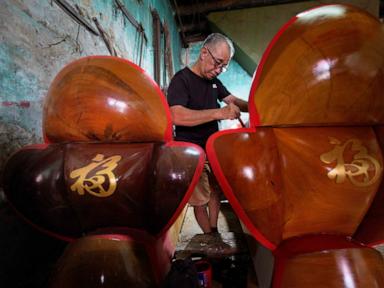
Goh Khuay Par has spent more than five decades making traditional Chinese coffins by hand in Malaysia, carrying on a family craft passed down through three generations MUAR, Malaysia -- It’s been 52 years since Goh Khuay Par carved his first Mei Hua coffin. The traditional Chinese design takes its name from the plum blossom, or “mei hua” in Mandarin, and has been part of his family’s trade in Malaysia for three generations. It was most likely a small, thin piece, like the ones his father had him make when he was just starting out.
His products became thicker over time for a more striking appearance. Each coffin is made by hand and requires extensive work. Years ago, when the workshop had more craftsmen and more orders, they could turn out up to five a month.
These days Goh and his brother make about two every six to seven weeks. Ethnic Chinese currently make up about 22% of Malaysia’s population, according to the country’s Department of Statistics. On occasion, Goh's workshop also made coffins for clients in Singapore, home to another large Chinese diaspora community.
Those orders have ceased. There’s no one to take over.” Traditional Chinese beliefs envisioned an afterlife that in many ways mirrored the world of the living, rather than the Christian or Islamic conception of heaven or hell as a person’s ultimate destination. Over time, Buddhism introduced ideas of reincarnation and karmic retribution, linking a person’s fate after death to their actions in life.
Ling said Taoist funeral rituals include the symbolic crossing of the “Naihe Bridge,” or Bridge of Helplessness. The rite symbolizes the deceased’s final departure from the world of the living and helps the family come to terms with the loss. Other traditions, however, provide ways for the living to maintain a connection with the dead.
During the Qingming Festival, observed each year in April, families visit ancestral graves with food offerings and burn incense and paper replicas of everyday goods for their ancestors. It should be made from natural, heavy and durable materials — much like the wood used by Goh — and, when affordable, from the finest timber. A high-quality coffin can also reflect the prestige and dignity of both the deceased and their family.
Extract — continue reading at the source.