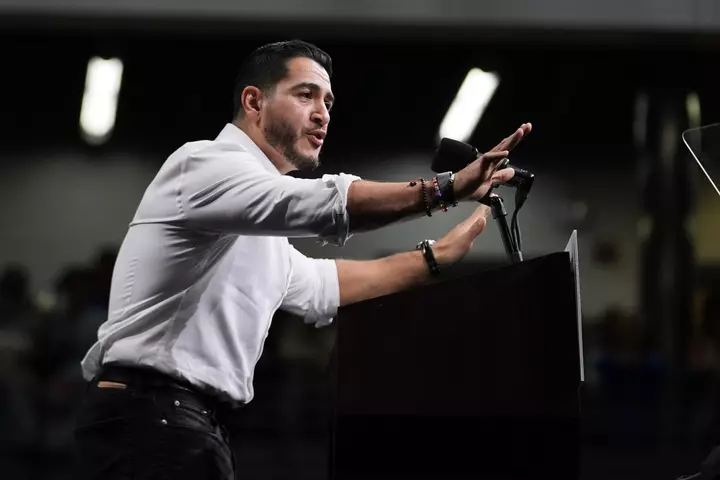
Let's set aside the fact that an advertisement supporting Michigan Democratic Senate nominee Abdul El-Sayed appears to reach into one of the ugliest reservoirs of antisemitic insinuation: the suggestion that Jews, or in this case the Jewish state, are somehow responsible for the economic misfortunes of ordinary Americans. Set aside, too, the difference between criticizing American aid to Israel and blaming the Jewish state for the price of eggs in Michigan, an insinuation that echoes centuries-old antisemitic accusations that Jews are responsible for other people's economic suffering. His campaign disavowed any affiliation with the advertisement, circulated by commentator Cenk Uygur on behalf of Rebellion PAC.
Yet its initial statement stopped short of calling the message antisemitic or explicitly condemning the accusation at its heart. Does that disavowal settle the matter? Or does El-Sayed's own record explain why the advertisement seemed plausible as an expression of his politics in the first place?
The question is less whether he authorized the message than whether his previous rhetoric has blurred the boundaries he now seeks to draw. El-Sayed has accused Israel of genocide in Gaza, advocated ending American military assistance to the country, including defensive aid, and drawn moral comparisons between Israel's government and Hamas. These are positions that can be debated on their merits, without presuming antisemitic intent.
Criticism of a government, however severe, remains distinct from prejudice against a people. Although those positions should be part of the conversation, the closer parallel lies in El-Sayed's response to violence against Jews, where critics have previously accused him of allowing grievances against Israel to intrude upon the condemnation of antisemitic violence. Following the attack on Temple Israel in West Bloomfield, El-Sayed condemned the violence, yet subsequently invoked the attacker's family losses in Lebanon and the phrase "hurt people hurt people." For Jewish critics, the troubling implication was that violence directed at a Michigan synagogue could somehow be understood through the actions of Israel.
The advertisement raises a related concern: that Americans' economic grievances can be explained by pointing toward the Jewish state. In both instances, the objection concerns the attribution of responsibility, and the ease with which Israel becomes implicated in suffering far removed from its borders. El-Sayed later apologized to Michigan Jewish Democrats, acknowledging that his condemnation should have stood on its own.
That apology is part of the problem as well as it establishes that El-Sayed recognized the problem with his earlier formulation. But it also makes the omission in his response to the advertisement more conspicuous. Having previously acknowledged the need for an unequivocal condemnation, why did his campaign's initial response confine itself to denying involvement?
Extract — continue reading at the source.