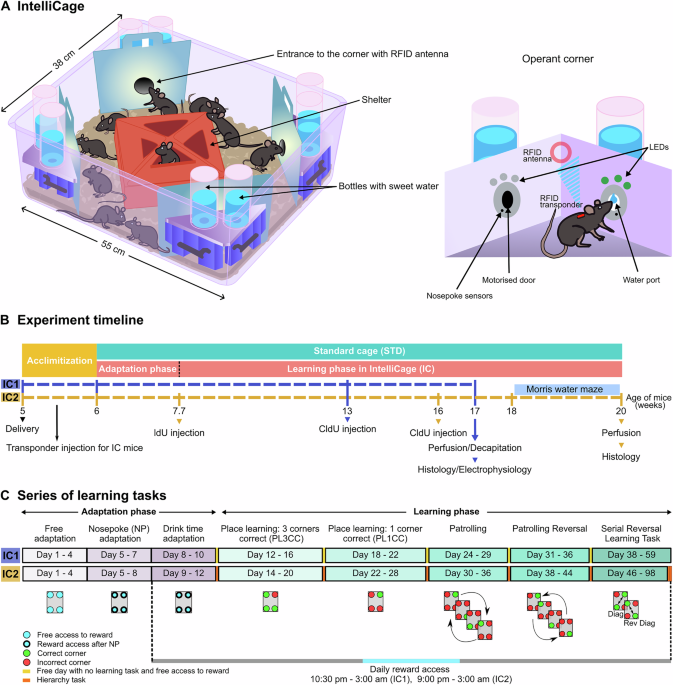
Humans select and learn goal-directed actions through the anticipation of their outcomes. While this ideomotor principle is well established in humans, its biological instantiation and relevance for organizing naturalistic behavior remain unclear, including its neurobiological substrates such as hippocampal plasticity. Here, we leverage high-resolution, continuous behavioral tracking in mice across a month-long series of automated learning tasks to test whether ideomotor principles generalize to naturalistic behavior and how they relate to adult hippocampal neurogenesis.
Mice lived in a shared enriched environment and engaged in self-initiated learning tasks, allowing us to quantify how action–outcome associations are formed, maintained, and updated. Despite identical genetic background and environment, animals showed stable individual differences in how these associations were organized. These differences correlated with levels of adult hippocampal neurogenesis: higher neurogenesis was associated with broader, more variable exploration and greater flexibility in updating action–outcome relations, whereas lower neurogenesis was linked to more rigid behavior.
Together, these findings link ideomotor theory to a cellular plasticity mechanism supporting flexible action control. Genetically identical (inbred) mice, even when housed in an identical environment, develop markedly individualized behavioral patterns1, including trajectories of exploratory behavior, learning patterns, and social interactions. The individual engagement of each mouse with the environment, including its social and physical aspects, appears to play a critical role in shaping these patterns.
Basic forms of behavior, such as those expressed by these mice, may provide a particularly direct, yet still to be tested, window into general principles of action. Ideomotor theory2,3,4 proposes that actions are selected through the anticipation of their effects5,6,7,8 and that these anticipations are learned through self-generated interaction with the environment9. Once acquired, action-effect couplings can be reactivated by internal representations that specify the currently desired action-effect (i.e., goals10).
These action-effect representations are referred to as event files6,11. Critically, event files are not static memory traces but are dynamically managed through binding and retrieval processes for which interrelated neurophysiological processes have been described12,13,14,15. Binding stands for the integration of action-related, sensory, contextual, and internal-state features into a coherent event file during experience, whereas retrieval reactivates these bindings when overlapping features or anticipated effects are encountered again16.
Through repeated cycles of binding and retrieval, action-effect representations become selectively strengthened, weakened, or updated, thereby shaping the repertoire of actions that are most readily selectable in a given context12,16,17. From this perspective, the exploratory engagement of mice can be understood as an ideomotor learning process, in which self-initiated interactions continuously generate new opportunities for binding and retrieval, progressively structuring and individualizing event-file repertoires. Accordingly, the individualized behavioral trajectories observed in genetically identical mice, in which genetic sources of variance in behavior are controlled for1, can be conceptualized as the gradual differentiation of event-files under identical external conditions (the so-called “shared environment”).
Extract — continue reading at the source.


