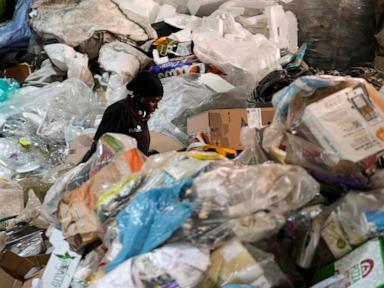
Johannesburg is struggling with a deepening waste crisis marked by unreliable collections, rapidly shrinking landfill space and a rise in illegal dumping JOHANNEBURG -- Two men sit on top of a hill at the end of a narrow road in Johannesburg ’s industrial suburb of Kya Sands. But the hill is no natural feature — it is a mountain of illegally dumped trash, piled so high it now swallows the road beyond. I could even drive my vehicle down this road,” municipal councilor Devon Steenkamp told The .
Adjacent to it, waves of waste spread across a valley as smoke rises and trucks unload more trash. Johannesburg’s mounting waste problem reflects a broader challenge across Africa. Rapidly growing cities, including Lagos, Dakar, and Accra, are generating waste far faster than many municipalities can collect, recycle, or safely dispose of it.
Africa’s urban population is projected to double by 2050 to 1.4 billion people, according to a joint report last year by the OECD, African Development Bank, Cities Alliance and United Cities and Local Governments of Africa. The United Nations Environment Program estimates that more than 90% of waste generated in Africa is disposed of at uncontrolled dumpsites and landfills, often with associated open burning. The World Bank projects that waste generation in sub-Saharan Africa will increase by 124% between now and 2050 — the fastest growth of any region.
In Johannesburg's densely populated Alexandra township, goats forage through piles of household waste as residents navigate sidewalks strewn with plastic, food scraps, and construction debris. Local resident Linda Makole, 75, is especially concerned about children, many of whom live in one-room homes and rely on sidewalks and a few parks for space to play. Some residents said their garbage went uncollected for up to four weeks.
The Johannesburg Crisis Alliance has blamed the disruptions on labor disputes, financial constraints, and an aging fleet. Unreliable waste collection has driven demand for informal waste haulers. Jordaan said that legal disposal required registration and landfill fees, prompting some informal haulers to dump waste illegally in areas like Kya Sands.
Bryce McCall, a former South African equestrian show jumper, has watched a separate dumpsite sprawl alongside his home, where he runs a stables and beekeeping business. We’ve got air purifiers in our bedroom,” McCall said. Suzan Oelofse, a principal scientist at South Africa’s Council for Scientific and Industrial Research (CSIR), said that poorly managed waste also attracts vermin and can clog stormwater drains, increasing the risk of flooding.
Extract — continue reading at the source.