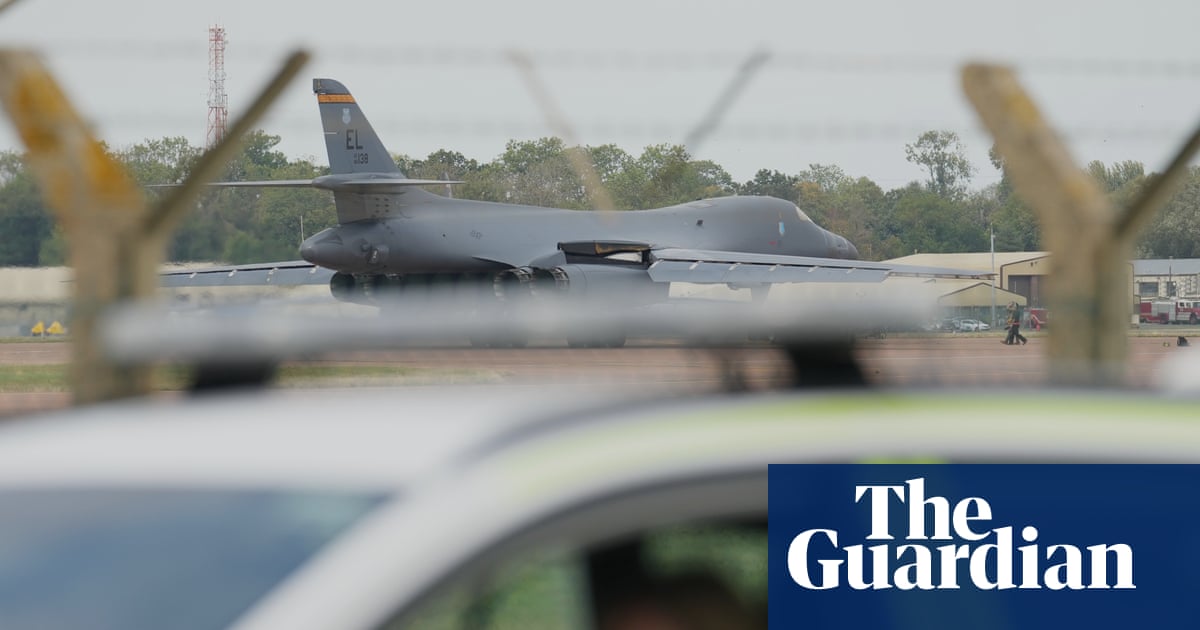
Britain may have been only peripherally involved in the bombing of Iran that Donald Trump and Benjamin Netanyahu started, but in the past fortnight it has become clear that Tehran wants to pose a threat inside the UK in response. In the aftermath of the confused incident near RAF Fairford, western officials are weighing up whether to warn publicly that Iran now has US military targets in Europe on its mind, such as the air force base in Gloucestershire. That could come even though there remains British scepticism about Iran’s capability to pull off a drone raid on a secure facility far from Tehran.
What is already accepted by MI5 is that Iran’s Islamic Revolutionary Guard Corps (IRGC) has sought to coordinate and promote the targeting of the Jewish community in the UK and Europe, starting from March with a string of arson attacks directed at synagogues and similar sites. That is itself a significant step up from the regime’s longstanding campaign of assassination plots and threats against critics overseas, tasks the IRGC has traditionally hired criminal gangs to carry out. Exactly what happened at RAF Fairford remains unclear, though Iran may have gained something from it for very little.
A week later, last Sunday, a worried US decided to withdraw the 12 B-1 bombers it had stationed there, with leaks to US media suggesting there was a fear of a Ukraine-style drone attack. What is known is that five men from London drove up in three white vans shortly after midnight on 27 September, one of whom called 999 as they did so. All five were arrested in Whelford, a village next to the airbase, only to be released on police bail a day later when no explosives were found or discernible plot discovered.
Two more men have been arrested on suspicion of terror offences, and released on police bail. Andy Burnham, the prime minister, has said there were “strong indications” Iran played a part, and on Thursday the Met police chief, Mark Rowley, said “you will see more progress on this investigation”. RAF Fairford is an exposed site, with plane spotters easily able to get up close enough to photograph and track the forward-deployed US B-1 and B-52 bombers, which with permission from the former prime minister Keir Starmer were taking off to make attack runs into Iran in the spring and early summer.
Given the use of Fairford by US bombers, it’s only prudent to assume that they would see an interest in attacking a wider range of targets, whatever their involvement in the Fairford incident,” said Lord Ricketts, a former UK national security adviser. Dr Antonio Giustozzi, a terrorism specialist with the Royal United Services Institute, suggests the drive to the village was “a feint” where individuals, who may have been unwitting, were sent “to hint at what could happen”. But he is sceptical that Iran could pose a real military threat to Fairford or elsewhere.
As for attacking Fairford, piloting first-person view drones of the type used in Ukraine is a skill requiring several days if not weeks of training, while an operation on an airbase would probably take months to prepare. A genuine attack on RAF Fairford or similar would almost certainly be a one-way mission ending in capture or even death, which it would be it hard to recruit for. But despite the low risks, the US chose to withdraw the B-1 bombers, which cost $300m (£225m) each, as a precautionary move.
Extract — continue reading at the source.