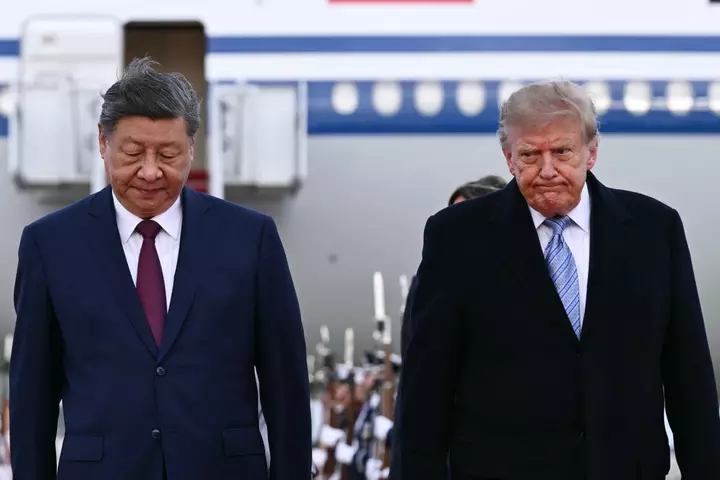
Donald Trump’s China policies are contradictory, veering between threats and flattery and, most recently, settling into an uncomfortable kind of détente. That has been evidenced by razzmatazz summits with Chinese leader Xi Jinping where not much gets discussed. Xi is said to loathe meeting him or even meeting his eye, despite Trump’s avowals of friendship.
In fact, for two years, Trump has flip-flopped; for example, onshoring semiconductor production on national security grounds, then selling national security-sensitive semiconductors hand over fist to China, all at the same time. His defenders say that China has the U.S. over a barrel because of its control of the rare earths that drive high-tech industry. They argue that Trump is above all buying time until the U.S. can establish its own supplies of the mining and processing of the minerals—or face losing its industrial power and sovereignty.
There’s a lot of truth to that. China is perhaps America’s single most important, long-term foreign policy challenge, due to its industrial might and ambition. This dwarfs any other country’s—despite the far noisier issue, among the electorate, of the Middle East.
Flush with their midterms victory, where do the Democrats stand on China, and can they work it out before 2028, when they have a serious chance of taking power? Should they critique Trump’s détente, as evidenced, for example, by his delay in supplying weapons to Taiwan and his rush to supply chips to China? Or should they lean into these policies?
That may be a good thing for the Democrats. The range of opinion in the party is great, from the "left left" Democratic Socialists who are still few, but who exert upward pressure, are strong in the grassroots and among young people, many of whom believe that China is "anti-imperialist" even though it operates assimilationist policies toward millions of its own ethnic minorities and in border regions such as Tibet, Xinjiang where the Uyghurs live, Inner Mongolia and Hong Kong. Then there are the Democratic centrists, some would say the realists, some of them alums of the former administration of President Joe Biden.
They view China as a serious national security challenge, and, when in power, worked for export controls for sensitive national security-connected technologies such as semiconductors that outstripped anything by Trump’s Department of Commerce under Howard Lutnick, but who moved more slowly against endemic espionage by China, apparently more worried about being accused of racism than combating the Communist Party's political warfare. Positioned opposite the realists is a progressive wing that believes, not so secretly, that China needs to be more or less appeased, or America risks war. For example, over Taiwan.
Extract — continue reading at the source.