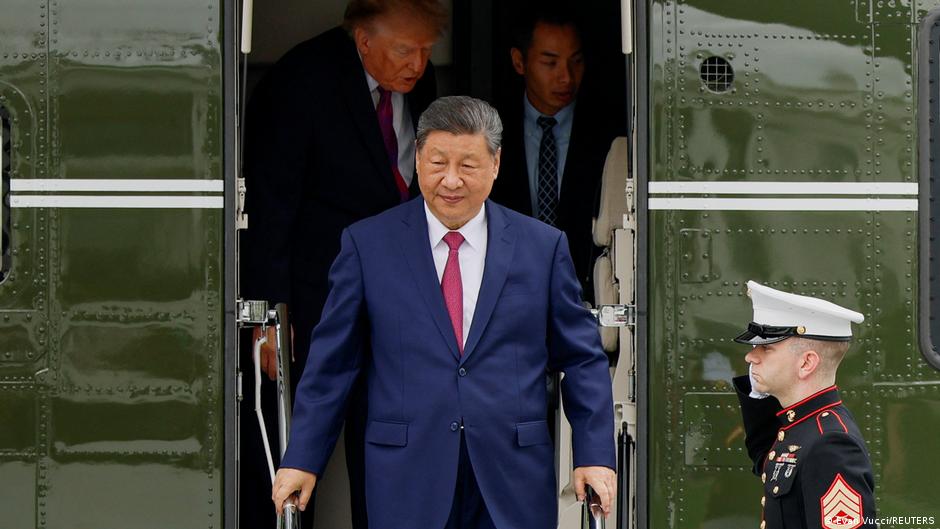
When US President Donald Trump rolled out the red carpet for Chinese leader Xi Jinping at Andrews Air Force Base on Wednesday evening, it was a rare diplomatic gesture that has only happened a handful of times in US history. Generally, world leaders are received by the president at the White House. Xi's VIP reception underlines the importance Trump places on his personal rapport with China's most powerful leader in a generation.
After 90 minutes of bilateral talks in the Oval Office, Trump spent Thursday afternoon showing his "good friend" Xi his various White House construction projects, including the helipad completed just days earlier over the South Lawn. He then welcomed Xi aboard the presidential helicopter Marine One for a brief tour. Trump then told reporters "we had a great meeting," adding that Xi "loves good granite." The optics continued at a glitzy state dinner Thursday night, where Trump said he and President Xi have "never gotten along better" and lauded building a "relationship that promotes prosperity and security for future generations." Judging from Xi's mannerisms, it isn't clear the Chinese leader shares Trump's enthusiasm for personal diplomacy.
When Trump arrived in Beijing for a summit in May, Xi sent diplomatic envoy, Vice President Han Zheng, to meet the US president. "Trump's 'personalized diplomacy' is a one-sided construct — one that exists mainly in his own mind. He may believe his personal rapport with Xi is the key factor shaping Sino-American relations, but there's little to no evidence backing that claim," said Aurelio Insisa, senior analyst at the Berlin-based Mercator Institute for China Studies (MERICS).
Xi's whirlwind visit to the US, his first in 10 years, has been heavy on pomp, but relatively low on substance. As of Friday morning, most summit coverage has focused on what was for dinner and the tech CEO guest list, in lieu of any deliverables on thorny issues like trade deals or cooperation on artificial intelligence. There is still time for announcements when Xi departs Washington later Friday after visiting the National Archives with Trump.
"The Chinese approach has shown no meaningful deviation in the US President's favor, beneath the usual pomp and circumstance of apex-level summitry," Insisa told DW. The most-pressing issue remains managing a trade war launched by Trump's scattershot tariffs in April 2025 that at one point were so high they essentially amounted to an embargo on Chinese goods. On Wednesday, US Treasury Secretary Bessent said a trade truce due to expire in November would be extended until January "to give us more time to see what we can do on the economic front." Such an extension had been widely expected before the summit.
The trade truce builds on the "Busan deal" Trump and Xi agreed on at a meeting in South Korea last October, where Trump backed off on more tariffs in exchange for Xi easing export control for rare earths, which are critical ingredients for building high-tech kit. Levering China's chokehold on rare earths to confront Trump's tariff blitz represented a major victory for Xi. The Financial Times reported earlier this week that the US "believes China has not fully lived up to its commitment of uninterrupted supply," adding that China's shipments of rare earths to the US have dropped recently, amid concerns China could again "choke supplies." To view this video please enable JavaScript, and consider upgrading to a web browser that supports HTML5 video On tariffs and trade, Trump made nebulous comments on Thursday about "progress," but no specific deals on sectors or goods have yet been reported as of Friday morning.
Extract — continue reading at the source.