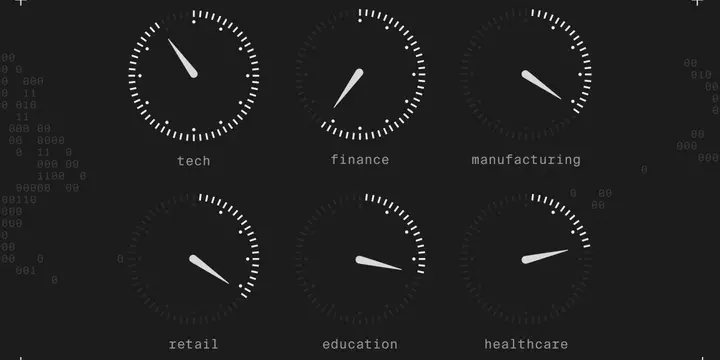
The current narrative around artificial intelligence in the workplace is largely driven by Silicon Valley. But treating the tech sector as an island misses the actual trends in technology adoption–tech is just the first industry in line. As generative AI and automation tools mature, the shifts currently reshaping software engineering and product management will inevitably filter into healthcare, education, retail, and manufacturing.
The variation in adoption rates today isn't a sign that non-tech industries are falling behind, but rather a reflection of the different speeds at which industries absorb new workflows. For leaders and their teams outside of tech, this differential pace provides a practical blueprint for how AI adoption unfolds, and where the opportunities lie. Recent survey data from TripleTen highlights just how stark the current adoption curve is across different sectors of the economy (see Figure 1).
Figure 1: The AI adoption curve remains steep across industries, but non-tech industry adoption rates are increasing. While tech leads the way, finance emerges as a clear second: 48% of finance workers have been asked to use AI chatbots, and 32% have been asked to automate parts of their workflow. This demonstrates how rapidly knowledge work integrates AI once clear use cases emerge.
By contrast, sectors like healthcare (18% asked to use chatbots) and education (25%) reflect lower initial exposure. Because these broad industry categories encompass a mix of specialized hands-on professionals, clinical or instructional personnel, and back-office administrative staff, universal adoption was never going to happen overnight. Integrating automated tools into compliance-heavy or human-facing operations requires a more deliberate pace, which is reflected by the lower numbers.
Across all surveyed industries, 79% of workers report being asked to learn at least one skill they didn't previously have. Looking at the specific competencies demanded in tech today offers a preview of the skill sets likely to shift into other sectors (see Figure 2). Figure 2: Workforces across industries are learning new skills.
Although some of these sound like niche skills confined to tech, many of them will translate to frontline work across sectors—from hospital systems managing patient logistics to school districts processing administrative reporting. One skill gets less attention than it should. Only 30% of managers and owners call judging whether AI output is right or wrong an absolute must, which puts it sixth on a list of seven.
Extract — continue reading at the source.