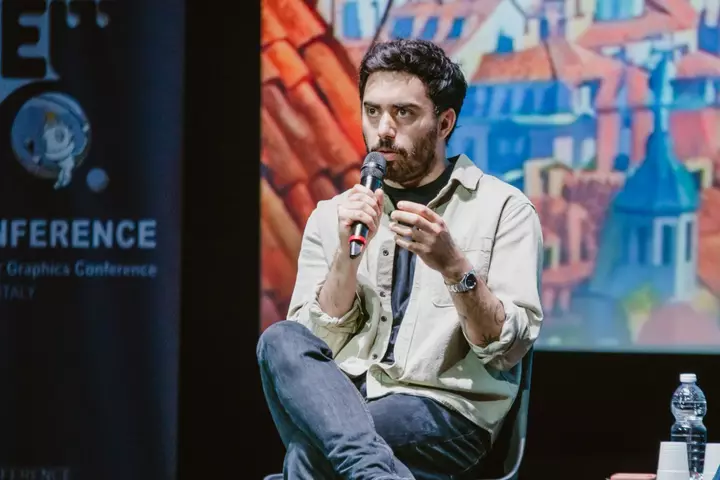
Speaking at a session, 'Every Pixel Will Be Generated,' the comments of Cristóbal Valenzuela, CEO of New York-based Runway provoked one of the biggest debates at View Conference, Europe's top VFX confab Durng a fireside chat entitled “Every Pixel Will Be Generated” at Turin’s View Conference, an audience member asked Cristóbal Valenzuela, the co-CEO of generative AI startup Runway, whether AI could eventually replace human actors. I think it’s already happening in a way,” he replied, going on to describe AI as “a new medium of expression” and “a new medium of storytelling.” His fellow speaker, Nvidia‘s Richard Kerris, was somewhat more attached to existing arrangements. Earlier in the session, he had recalled a director’s argument that the spontaneity between a director and an actor, such as Marlon Brando improvising with a cat on the set of “The Godfather,” could never be prompted.
Kerris had also stressed that filmmaking still requires an understanding of character, composition and story. There is no “make movie button.” A clear sense of what this might mean sits in Vaenzuela’s essay titled “It’s All About the Pixel Economy,” in which Valenzuela predicts that “the value of creating pixels is trending towards zero.” Eventually, he writes, the number of “seconds consumed” will converge with the number of “seconds generated.” Presently, a film often takes hundreds of people to make and millions of people two hours to watch. Valenzuela imagines a future where audiences generate personalized entertainment as quickly as they consume it.
In another essay, “The Cost of a Frame,” Valenzuela charts a history of media through the cost of producing a credible frame. The relevant layer is the high production value content. It’s that tier in which Hollywood, and much of the conference’s professionals, work in.
At the View fireside chat, Kerris frequently framed the resistance toward the technology as no different than the fears that previous tech advances stirred, including the emergence of computer-generated imagery. Jeff Kember, Nvidia’s principal technical evangelist for media, painted a similarly optimistic vision in his presentation, “Creative Control in the Age of AI Agents,” claiming that adoption is already widespread. I don’t know anyone who isn’t.” Between sessions a number of VFX artists, game studio heads, and animation directors spoke less of fear and more of anger relating to something peculiar and unique to the generative models, namely the material used to train on in the first place.
Asked by Variety about the training data behind the models, Valenzuela said one of the “core misbeliefs” about AI was that “people thought AI was some sort of a database.” “They’re not databases,” he said. In July, a federal judge approved Anthropic’s settlement of $1.5 billion with authors whose books were downloaded from pirate libraries. A prior ruling had found that using copyrighted works to train models could constitute fair use, while distinguishing that question from the company’s acquisition and retention of pirated copies.
Meanwhile, there are a number of lawsuits against many of the biggest AI companies still going through the legal system. One is a proposed class action case by visual artists against Stability AI, Midjourney, DeviantArt and Runway itself. It alleges that their copyrighted work was used to develop the generative models without compensation or permission.
Extract — continue reading at the source.