When voters cast their ballots, their votes are supposed to remain secret: from their family, their neighbors, and the government. But what if artificial intelligence could make secret votes visible? Last month, Max Springer, a postdoctoral research fellow at Princeton University’s Center for Information Technology Policy, tested the prospect of identifying voters based on their Georgia ballots with a $20 subscription to an AI large language model and data obtained from an Open Records Act request.
Ballot secrecy is a democratic safeguard, allowing voters to shield their selection from anyone who might try to influence or intimidate them into voting a certain way. But Springer’s test showed that he could use AI to find out who people voted for, using Georgia’s public election records. Georgia’s state elections board held an emergency meeting on Thursday morning to discuss how artificial intelligence has made it easier to identify voters through their ballot code, leaving people more vulnerable.
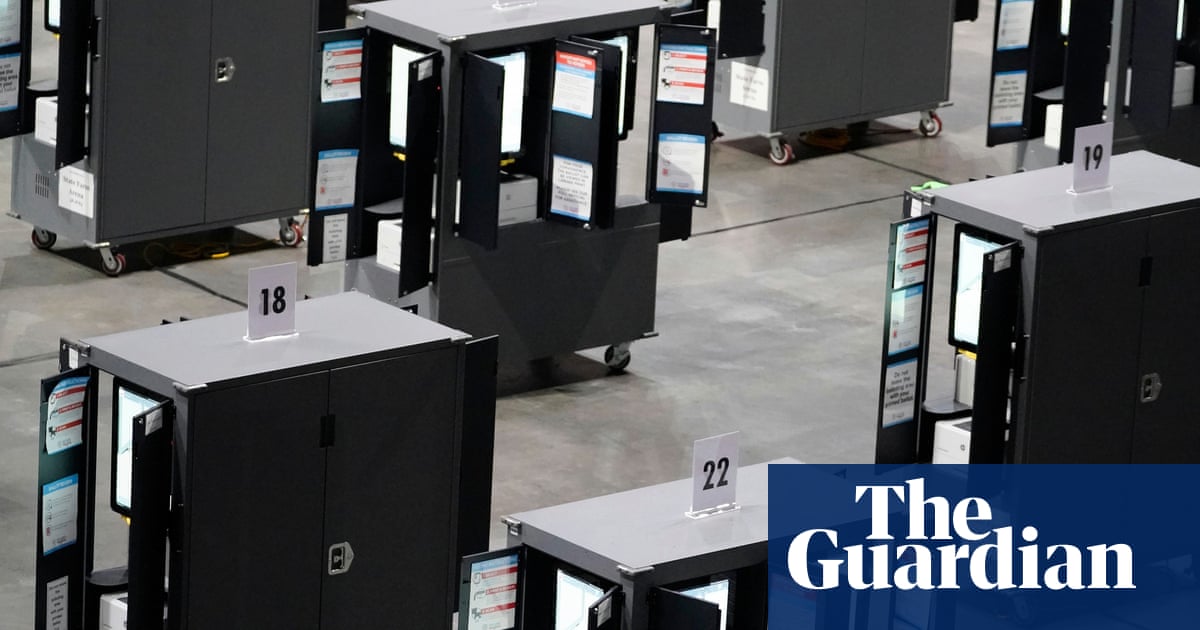
Georgia’s outgoing secretary of state, Brad Raffensperger, locked down the tabulation data that someone might use to identify a voter, ordering any public release to redact the ID numbers after an election, which “substantially address[es] this flaw”, said Ben Adida, an MIT-trained cryptographer and the founder of the election technology non-profit VotingWorks, as he addressed the board on Thursday. Election workers make a record of every voter who comes through a polling place. Voters then choose candidates on a touchscreen, which then prints out a paper ballot.
The voter feeds that ballot by hand into a scanner to be tabulated. Think of it as a row in a spreadsheet. One row is one scanned ballot.
It’s often called a cast vote record, or CVR for short. In order to later retrieve the CVR, the tabulator assigns a unique identifier to each CVR at the time of scanning.” The flaw shows up in how the machine records that ballot, Adida said. The identifying is not actually random enough.
Using AI, the early-voting list and the cast-vote record file for each county, Springer, the Princeton researcher who says he’s never been to Georgia, could recover the voting order for 1.52m ballots, or 98.9% of in-person ballots in 114 of the 139 counties he examined. In places with few voters on any given day, like tiny Heard county, Springer said: “the agent was able to match the majority of the 650 early in-person voters to a specific ballot, and the rest to within a single swap.” About four years ago, election security researchers had discovered a flaw in the software used by Georgia voters that could connect a voter’s identity to their secret ballot. The fact that ballots have an identifying number assigned at all is a product of the political paranoia attending Georgia’s elections.
Extract — continue reading at the source.