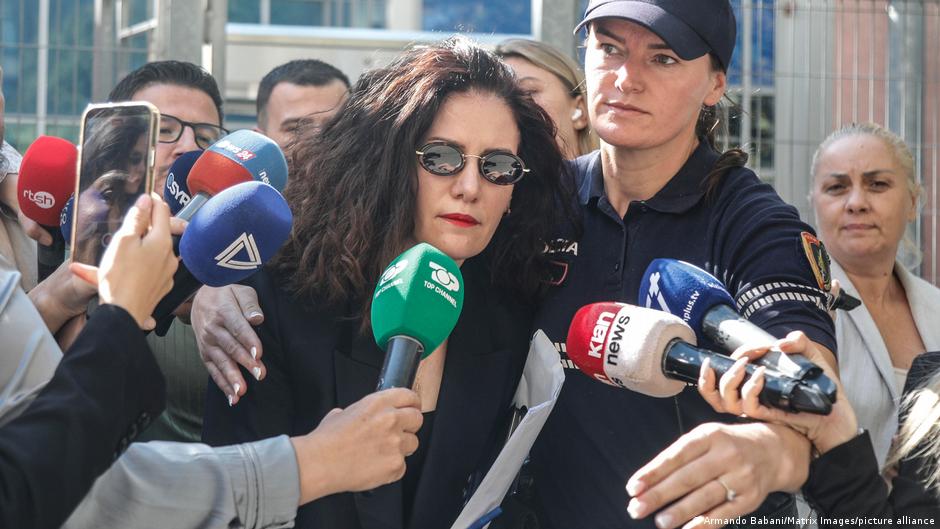
On September 22, the head of Albania's State Intelligence Service, Vlora Hyseni, was in Baku, Azerbaijan, attending an international conference of intelligence service chiefs. Back in Tirana, the Special Court had ordered her house arrest over two suspected criminal offences: supporting the perpetrator of a crime and disclosure of investigative secrecy. The investigation into Hyseni emerged from a wider corruption case involving the National Agency for Information Society (AKSHI), the agency responsible for much of Albania's digital public infrastructure.
Prosecutors suspect that she used information available to her as intelligence chief to help a person wanted in that investigation. Hyseni turned herself in to the Albanian authorities later that day and remains under house arrest as the investigation continues. She has since been dismissed as head of the intelligence service.
Hyseni's case is the latest in a series of criminal proceedings that have reached unusually high into Albania's political and state establishment. A former president has spent almost two years in detention, a former prime minister is on trial, the mayor of Tirana has been behind bars since early 2025, two former deputy prime ministers under Prime Minister Edi Rama have also faced criminal proceedings, and investigations have been launched into senior officials in agencies controlling large areas of public spending and state infrastructure. These are all separate cases, but they all involve alleged abuse of public power.
For years, the problem was completely the opposite: High-level corruption in Albania was widely associated with impunity. This is why bringing senior political figures accused of wrongdoing before the courts became one of the central expectations of the justice reform launched in 2016. "The expectation was that the new justice institutions would focus on high-level corruption and 'VIP' cases," says Afrim Krasniqi, a political scientist and executive director of the Institute for Political Studies in Tirana.
"There were individuals who stood above the law, and impunity was pronounced," he told DW. The reform fundamentally reshaped Albania's justice system and created new institutions to investigate corruption and organized crime, including the Special Anti-Corruption Structure, SPAK. But the change was not immediate.
Building the new institutions took years, and older cases were often more difficult to investigate. For Dorian Matlija, a lawyer and executive director of Albanian civil society organization Res Publica, the number of senior officials now facing criminal proceedings does not necessarily mean that corruption is more widespread today than it was in the past. "What has changed significantly is the institutional reaction," Matlija told DW.
Extract — continue reading at the source.