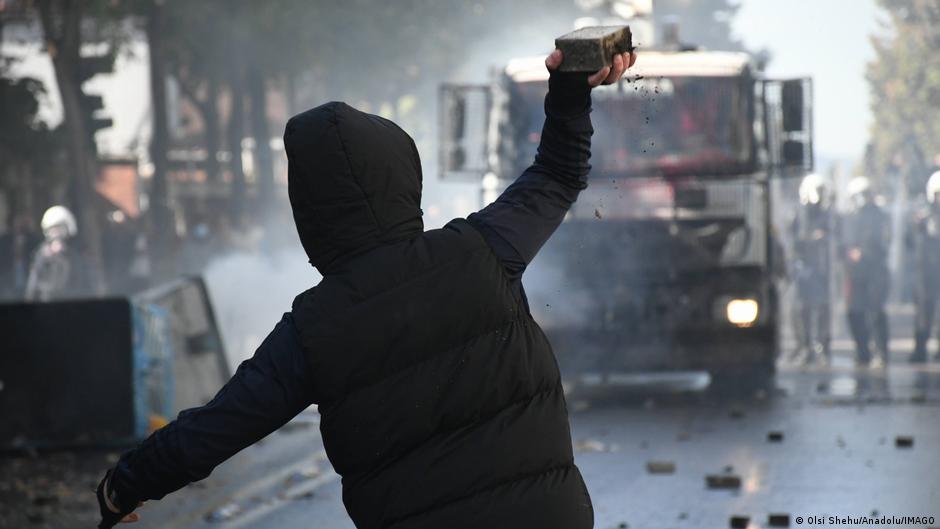
The fallout from the October 13 protests was still visible when students and faculty from the University of Tirana gathered outside the Education Ministry in Albania's capital on Tuesday to express their continued discontent. Smashed windows have yet to be replaced; the walls are still black with soot from fires that broke out during the protests. Albania has seen nearly five months of peaceful anti-government protests, sparked initially when plans were made public that Jared Kushner — a son-in-law of US President Donald Trump — and associates intended to build a luxury hotel complex within a nature reserve.
Since then, anti-government and anti-corruption protests have escalated. Now, college and high school students clash with police forces almost daily, with the fiercest clashes so far occurring last week. To view this video please enable JavaScript, and consider upgrading to a web browser that supports HTML5 video Protesters denounce corruption, mismanaged universities and the rising cost of education in Albania — and call for the resignation of Prime Minister Edi Rama, who has been in office since 2013.
Wearing a black hooded jacket and a scarf across her face to conceal her identity, a woman who asked to be called Sara because she fears repercussions for speaking to the press told DW that protesters "communicate via text messages — that's the only way." She cut the interview short as some protesters began flinging stones at the Education Ministry. Police pushed demonstrators and journalists out of the way, using water cannons to disperse the crowd. "Social media is the most important public space today — more so than physical spaces," Besmir Semanaj, a prominent Albanian cybersecurity advocate told DW.
"Young Albanians no longer organize through traditional structures such as political parties, associations or public appeals. Instead, they organize themselves where they spend much of their daily lives: on their cellphones." "The most important communication channels include Instagram, WhatsApp groups for academic-year cohorts, departments and dormitories, Telegram channels for general announcements, and TikTok for sharing videos," Semanaj said. He added that people who are especially concerned with security use the Signal messaging app.
"This is a horizontal organizational structure, without individual 'leaders' and without a central command structure," Semanaj said. "That is exactly why the government is having such a hard time understanding and controlling the situation." Semanaj said the Telegram messenger app had proven particularly useful for protesters. "Telegram channels allow you to reach tens of thousands of people at once," he said.
"Notifications are sent out within seconds, and external control is more difficult to establish than on traditional platforms." Rama has called the youth uprising a "hybrid war." He said protesters thought they could "make Albania a better country through TikTok and without even being able to string together more than seven coherent words." Though not all are terrorists, he said, he believes that "they are hostages to a certain mindset, a new ideology that has only one goal: to destroy, to turn everything upside down, to raze everything to the ground." Over nearly five months, Rama has accused various "true" masterminds of organizing the anti-government and anti-corruption protests. He has alleged that the governments of Greece, Russia and Iran are stirring up dissent. Most recently, Rama said it was "antifa" — or a decentralized movement of global antifascists — that had stoked anti-government and anti-corruption sentiments in Albania.
Extract — continue reading at the source.