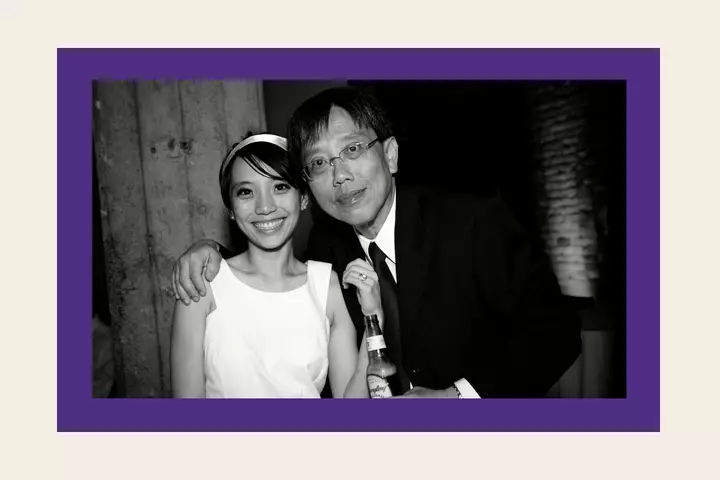
Before he was diagnosed with ALS, Dad would listen to recordings of himself and declare that he didn’t like the sound of his own voice. Dad had always been a talker. On many occasions (often unasked) he had been a singer too.
At the house I grew up in, his voice boomed through the walls at Christmas (“Come, they told him PA RUM PUM PUM PUM!!!”) At patient home visits for his work as a hospice doctor, his songs filled the silent spaces as he held their hands and sat with their families. At my wedding years ago, he went table to table singing “Hava Nagila” with aplomb. (He did not speak a lick of Hebrew.) What Dad lacked in pitch and timbre, he made up for in volume and enthusiasm. Nothing a little na na na can’t handle.
Once, he told me that when he was young he had been shy about being a poor singer, and had shrunk from any opportunity to sing. In middle age, a good friend who had long sensed Dad’s hidden passion encouraged him to come out of his shell. Dad was eternally grateful to this man and his portable karaoke machine.
Dad may not have liked the sound of his voice, but he had owned it and wanted to keep it. I saw my mission clearly. After months of researching clinical trials, side-eyeing doctors and going down the “miracle cure” rabbit hole on social media, I had come to accept that I was not going to be The One Who Fixes Dad’s ALS.
I had worked in tech for years. I grasped at the one thing I still had the hubris to believe I could be: The One Who Gives Dad Back His Voice. Dad had read about message banks: platforms for patients to record their voice while they still can, speaking a set of predetermined key phrases like “I’m hungry” or “take me outside” or “I’m in pain.” When patients lose their speech and (most) movement, the message bank can be connected to an augmentative and alternative communication (AAC) device, designed for patients with limited mobility to trigger any one of those phrases when they want to.
I thought, how primitive. My LinkedIn feed that year was frothing over all things artificial intelligence. Another day, another 10,000 mindblowing audio/visual demos: We can make your video game character follow your eyes!
Extract — continue reading at the source.