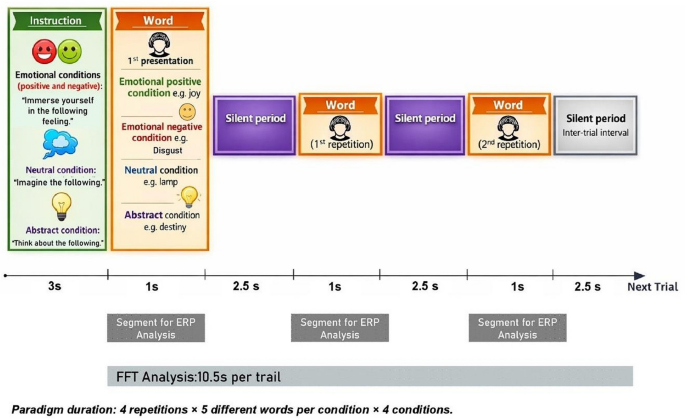
Major depressive disorder (MDD) has been associated with alterations in emotional processing, brain activity, and autonomic regulation, potentially reflecting impaired coordination between neural and autonomic systems. This study examined whether these alterations are more clearly reflected in distinct measures of brain activity or autonomic nervous system measures (HRV) during emotional mental imagery and investigated associations with mood and cognitive functioning. Therefore, thirty-seven healthy controls and 35 patients with MDD completed an auditory-guided imagery paradigm including positive, negative, neutral, and abstract conditions during EEG and ECG recording.
EEG data were analyzed using event-related potentials (ERP), spectral power, and event-related synchronization/desynchronization (ERS/ERD), alongside heart rate variability (HRV) indices derived from ECG. All participants completed mood questionnaires and cognitive assessments. Patients showed higher depressive symptom severity, more negative current mood, and reduced executive performance.
Further group differences emerged in alpha, gamma, and delta bands, whereas ERP amplitudes did not differ between groups. Altered neural oscillations were associated with reduced cognitive efficiency and greater depressive symptom severity. HRV measures indicated higher sympathetic nervous system and stress indices in patients, suggesting altered autonomic regulation.
Importantly, correlations between delta ERS/ERD activity and HRV indices were observed in healthy controls but not in patients with MDD. These findings suggest that depression-related alterations are more strongly reflected in neural oscillations and autonomic regulation than basic emotional response patterns. Neural and autonomic markers may therefore provide clinically relevant information on cognitive difficulties, stress regulation, and disrupted brain–body interactions in MDD.
Major depressive disorder (MDD) is characterized by disturbances in mood, emotional processing, cognition, motivation, and stress responsivity1,2. Beyond these core symptoms, patients frequently experience impairments in attention, executive functioning, memory, and decision-making, which substantially contribute to psychosocial dysfunction and occupational disability. Neurobiological models propose that altered interactions between prefrontal regulatory regions and limbic structures contribute to maladaptive emotional processing, negative cognitive biases, and impaired stress regulation, suggesting disrupted coordination between affective, autonomic, and cognitive domains2.
In previous research, emotional processing has been referred broadly to the modulation of affective responses, whereas stress regulation has been referred to autonomic adjustment to internal or external demands. Although considerable progress has been made in understanding the neurobiology of depression, the mechanisms underlying emotional and cognitive disturbances remain incompletely understood. Electroencephalography (EEG) allows the investigation of both event-related potentials (ERPs) and oscillatory brain activity, providing insight into emotional and cognitive processing.
Extract — continue reading at the source.


