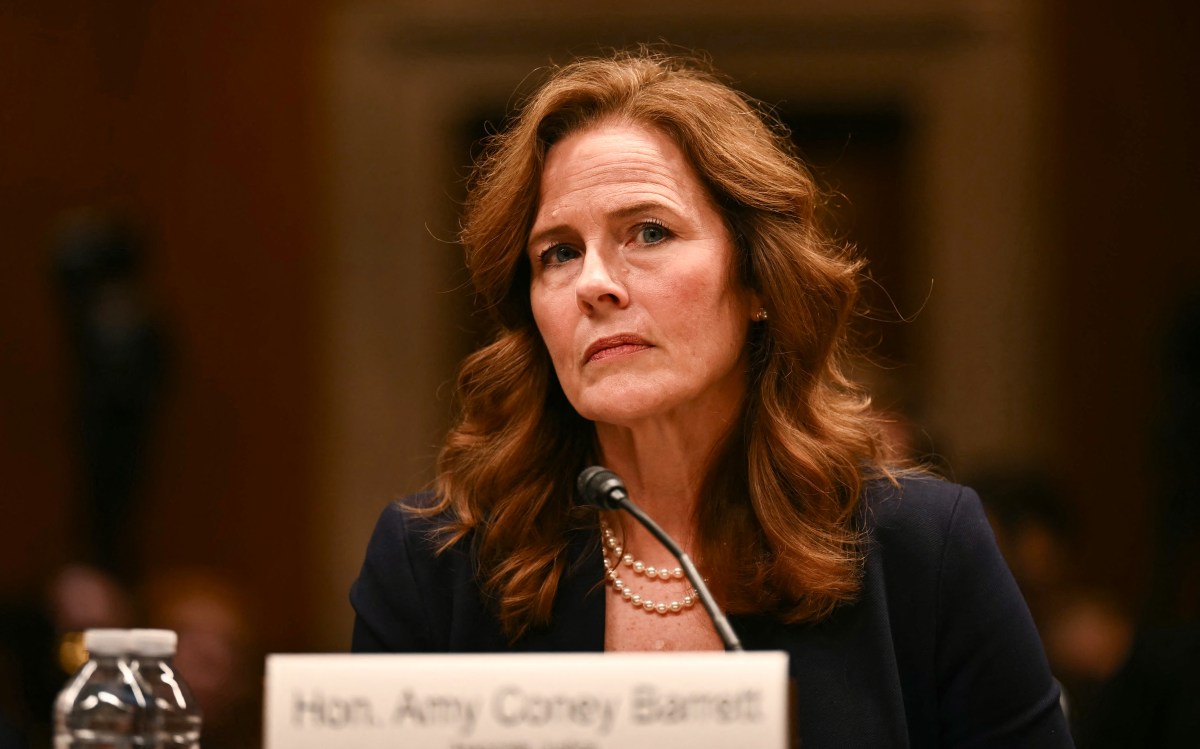
The Supreme Court's new term opened Monday with a potentially landmark case pitting states and local governments against some of the world’s largest oil firms. The case asks whether states can hold oil giants liable under state law for climate change-related effects like rising seas and storms, and for the billions of dollars in resulting damage to property and infrastructure. During oral arguments on Monday, Justice Amy Coney Barrett raised a “quibble” about how much authority state law has over federal regulations on interstate pollution.
Advocate Kannon Shanmugam, representing the fossil fuel firms, argued that Congress authorized state law “to apply in a very specific context,” and that precedent points to interstate pollution as a fundamentally federal domain without congressional authorization. Barrett interjected that precedents like American Electric Power Co. v. Connecticut (2011) did not show Congress intervening to provide authorization, but that the law “preserved some state authority” that already existed.
It just left alone some of that preexisting authority, maybe some of which might be affected by the Clean Air Act.” In 2018, the city of Boulder, Colorado, sued oil giants Suncor and ExxonMobil over their alleged role in contributing to climate change and for misleading the public about it. The Supreme Court is now weighing whether this case can proceed under state law. The defendant oil firms have asked the U.S.
Supreme Court to toss the case, arguing that federal law preempts state law in these matters, and that the Clean Air Act specifically prohibits such lawsuits against energy companies. Allowing the case to move forward would be groundbreaking, as the oil companies have themselves acknowledged, paving the way for further suits against firms over their alleged role in climate change and any associated destruction. Unleashing juries nationwide is a recipe for disaster,” the defendant companies wrote in a brief submitted to the court.
Justice Samuel Alito recused himself from the case last week. The letter disclosing this decision did not state a reason, though this followed questions over his holdings in oil companies; Alito has in the past recused himself from cases involving companies in which he had a “financial interest.” Given this and the potential for a 4-4 deadlock, attention will be on the court’s more central conservatives, Chief Justice John Roberts and Barrett, who will be watched closely for indications of how the case may unfold. In analogous cases, Roberts has expressed concerns about the potential impact of burdensome regulations and reinterpretations of climate-related statutes on businesses.
Internal memos uncovered by The New York Times earlier this year alleged that Roberts “acted as a bulldozer” to stop former President Barack Obama’s Clean Power Plan from taking effect on these grounds. In one memo, Roberts cited an estimated cost of $480 billion for the plan, higher than the U.S. Environmental Protection Agency's official estimates.
Extract — continue reading at the source.