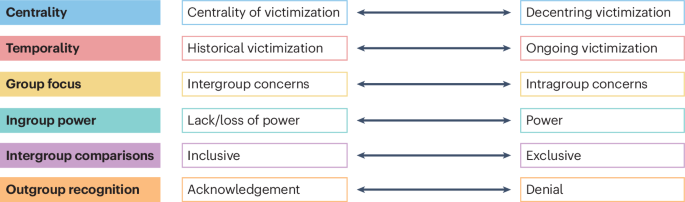
A common idea is that violence begets violence, such that people desire revenge or support preemptive, violent self-defence when their group has been harmed. However, this response is not inevitable — there is also solidarity within and across groups in the context or aftermath of collective violence. Therefore, it is theoretically and practically important to understand when collective victimization gives rise to which responses.
Critically, different responses to collective victimization might arise from differences in how people make sense of and think about their group’s collective victimization — that is, their collective victimization beliefs. In this Review, we organize collective victimization beliefs and their consequences according to the phases of the appraisal–coping model: primary appraisal, secondary appraisal, coping efforts and coping outcomes. This framework draws on research in social psychology, clinical and counselling psychology, liberation psychology, and adjacent fields and can help to explain different responses to and outcomes of collective victimization on the individual and societal levels.
Overall, this framework showcases the breadth and complexity of collective victimization beliefs, which need to be considered in future research and theorizing to better understand how collective violence and its aftermath might be linked to both destructive and constructive outcomes. This is a preview of subscription content, access via your institution Receive 12 digital issues and online access to articles Prices may be subject to local taxes which are calculated during checkout Vollhardt, J. Collective victimization.
In The Oxford Handbook of Intergroup Conflict (ed. R.) 136–157 (Oxford Univ. Bar-Tal, D., Chernyak-Hai, L., Schori, N. & Gundar, A.
A sense of self-perceived collective victimhood in intractable conflicts. Red Cross 91, 229–258 (2009). Historical trauma as public narrative: a conceptual review of how history impacts present-day health.
Med. 106, 128–136 (2014). Article PubMed PubMed Central Google Scholar Martín-Baró, I. Writings for a Liberation Psychology (Harvard Univ.
Extract — continue reading at the source.