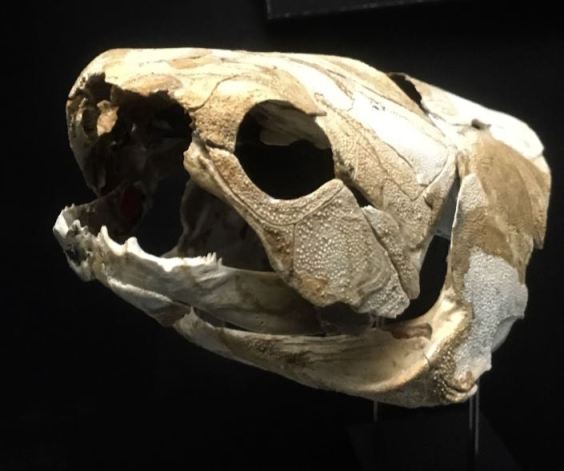
Jaws and teeth were a radical adaptation in the evolution of vertebrates, allowing animals to eat hard prey and opening up a whole new range of feeding opportunities. Based on the fossil record, the earliest jawed vertebrates were the placoderms—fish with bony jaw plates that served as cutting surfaces and sometimes bore tooth-like structures. A recent study published in Scientific Reports shows that placoderms evolved a diverse range of jaw and dental morphology, reflecting their diverse diets.
Researchers from Flinders University in Australia compared eight species of placoderm known from the approximately 385-million-year-old Gogo fossil formation, which used to be a marine ecosystem, in western Australia. Read more: “These Ancient Sea Worms Have ‘Biomedal’ Jaws” Their jaw fossils were either micro-CT scanned or surface scanned to provide data for 3D modeling of their shapes. The models were then used to simulate the bite mechanisms and forces of these ancient fish.
The results showed that not all placoderms were alike; they varied in the stiffness and dental complexity of their jaws. For example, the dental plates of the smallest placoderm (Rolfosteus canningensis) were smooth and flat, while the largest placoderm (Kimberleyichthys sp.) had raised, tooth-like structures on a bony crest. The study authors hypothesize that smaller placoderms ate smaller prey, which they could crush between the jaw plates.
But the big placoderms would have required more calories, favoring prey that would have to be ingested in pieces. The study authors compare the toothed crest of the big Kimberleyichthys to a medieval war hammer or poleaxe, weapons designed to puncture and crush the era’s armor. Its specialized jaw likely allowed it to puncture hard-shelled prey and then break them into pieces.
The smooth, flat plate of the smaller R. canningensis was more like a flanged mace or other blunt crushing weapon with a sharp edge. Subscribe to our free newsletter.
Extract — continue reading at the source.