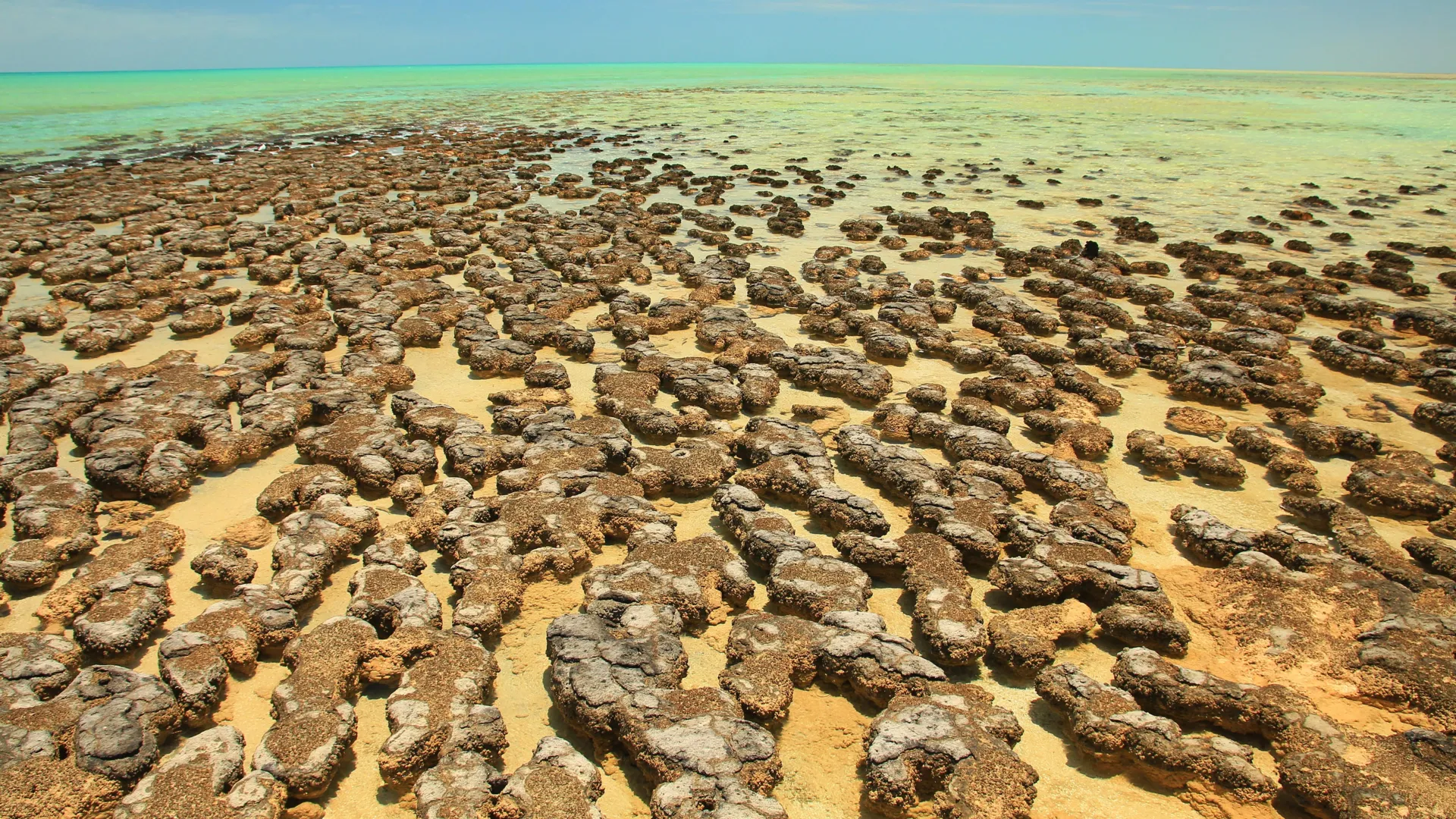
At first glance, stromatolites and their close relatives, microbial mats, can look like little more than dark, ancient rocks. In reality, they are densely packed, layered communities built by microbes. Billions of years ago, before animals and plants existed, stromatolites helped release some of the earliest oxygen into Earth's atmosphere.
Now, a study published in Current Biology suggests these unusual formations may also preserve clues to another major event in Earth's history: the emergence of complex life. Associate Professor Brendan Burns, an evolutionary microbiologist at UNSW Sydney, is part of a research team that discovered a previously unknown microbe living in close association with another organism inside these "living fossils." The project, co-led with researchers from the University of Technology Sydney and The University of Melbourne, could help scientists better understand a fundamental evolutionary mystery: how relatively simple cells began cooperating and eventually gave rise to much more complex forms of life. "Stromatolites could be more than 'just' a cradle of life where early microbial life flourished," says A/Prof.
"They could also tell us how complex life first emerged." A Microbial Partnership With Ancient Roots Stromatolites and microbial mats first appeared billions of years ago, but they have not disappeared. They still form today in Shark Bay, a World Heritage-listed site in Western Australia. Samples collected there eventually led A/Prof.
Burns and his colleagues to isolate a member of the Asgard archaea, an unusual group of microbes believed to be closely related to the ancestors of eukaryotes, which are the cells that make up all plants and animals, including humans. One long-standing idea in biology proposes that the first eukaryotic cell developed through an intimate partnership between an ancient archaeon and a bacterium. According to this theory, one organism eventually engulfed the other, and that relationship ultimately produced mitochondria, the energy-producing structures found inside complex cells.
Scientists, however, have lacked direct evidence showing what such an early partnership might actually have looked like. The new research provides the first visual evidence of an Asgard archaeon physically interacting with a bacterium through extremely thin, tube-like connections called nanotubes. "This could be a little model for how these kinds of partnerships started and ultimately formed eukaryotes," says A/Prof.
Years Spent Trying to Grow an Elusive Microbe Genetic sequencing showed that the organisms' DNA was present in the samples, but getting the microbes to grow in the laboratory so researchers could study them directly proved far more difficult. "It took four or five years in the lab," A/Prof. "A lot of time, optimizing and chasing different shadows." Asgard archaea are notoriously challenging to cultivate away from their natural habitats.
Extract — continue reading at the source.