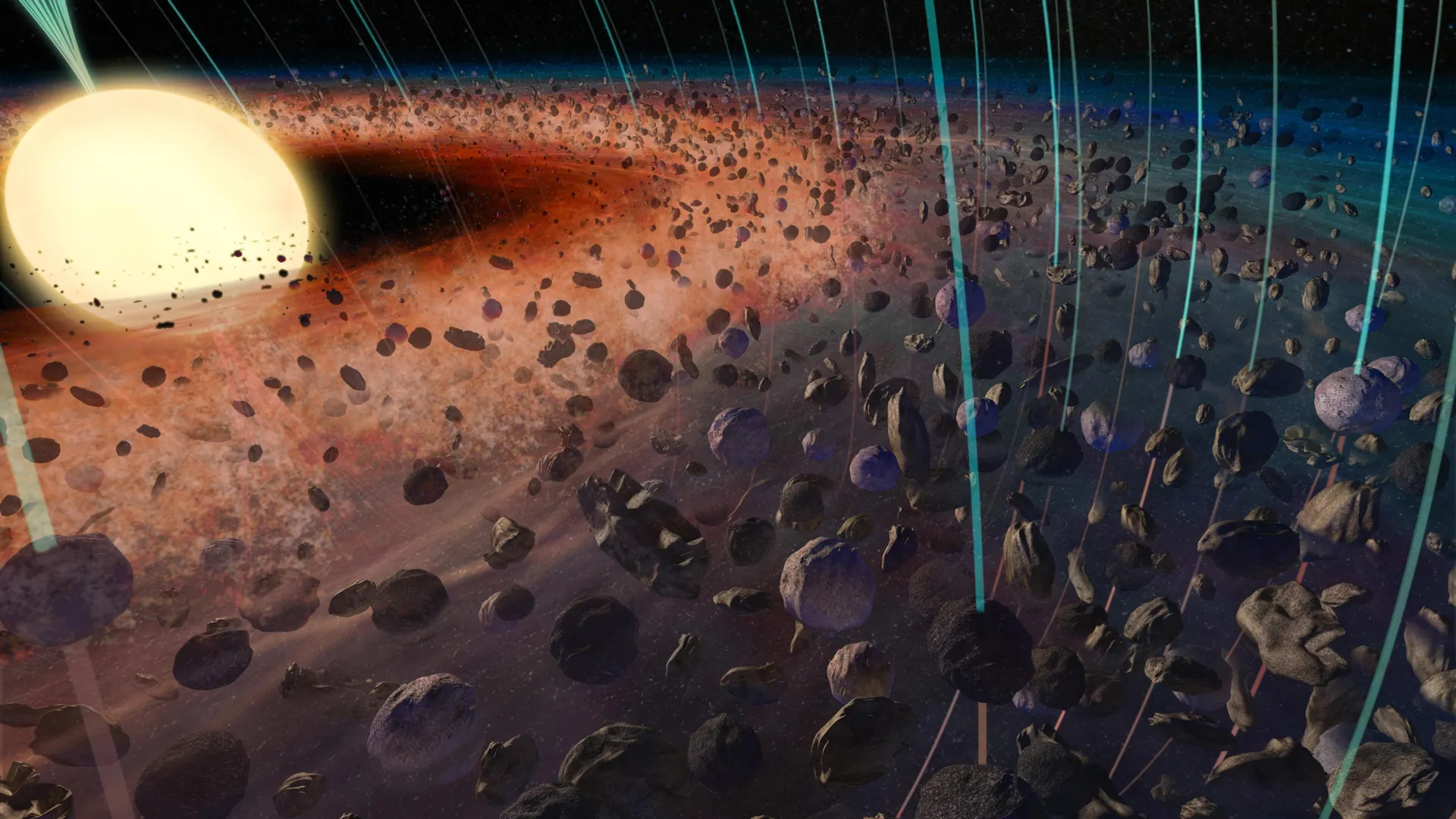
About 4.6 billion years ago, the solar system began as an enormous cloud of gas and dust. Over the next several million years, this "solar nebula" changed dramatically. The cloud collapsed and flattened into a disk, eventually giving rise to the sun at its center and the planets that formed around it.
Gravity has long been considered the main force behind this transformation. New research from MIT, however, suggests that magnetism may also have been an important part of the process. Scientists found evidence of ancient magnetic fields preserved in some of the oldest meteorite material ever identified.
The researchers studied microscopic grains inside a meteorite discovered in Antarctica in 2008. Known as calcium-aluminum-rich inclusions, or CAIs, these grains formed during the solar system's first 200,000 years and represent the oldest known material from that period. Their magnetic signatures indicate that a substantial magnetic field was already present during the solar nebula stage.
The researchers estimate that this field was stronger than Earth's magnetic field today and may have helped move primordial material inward as the young sun formed. "This transition, from a spherical cloud to a protoplanetary disk, is one of the most significant events in all of solar system history," says Benjamin Weiss, the Robert R. Shrock Professor of Earth and Planetary Sciences at MIT.
"It has long been theorized that gravity caused this, but our measurements show magnetism likely played a role." The findings were reported in the Proceedings of the National Academy of Sciences. Along with Weiss, the study's MIT co-authors are first author Cauê Borlina PhD '22, Elias Mansbach PhD '24, and Nilanjan Chatterjee. Other collaborators include Xue-Ning Bai of Tsinghua University, Po-Yen Tung and Richard Harrison of Cambridge University, François Tissot of Caltech, and Kevin McKeegan of the University of California at Los Angeles.
How Early Solar Magnetism Could Have Worked Magnetic fields arise when electrically charged matter moves. During the earliest stage of solar system formation, the collapsing cloud of gas and dust may have generated a plasma containing charged particles. As those particles circulated through the developing disk, they could have created and maintained a magnetic field.
Extract — continue reading at the source.


