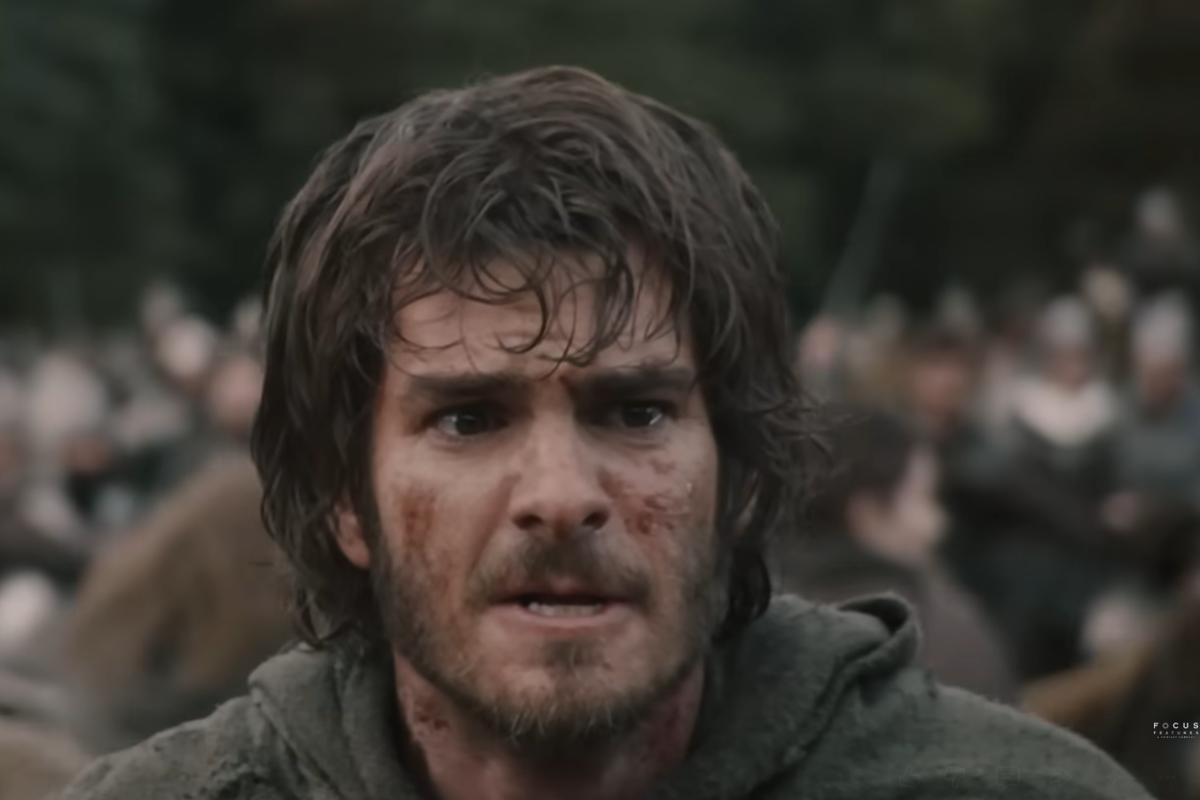
Andrew Garfield’s The Uprising has sparked a bizarre marketing row after its US distributor suddenly presented the film as a Robin Hood origin story, only for the title to disappear a day later. The film, written and directed by Paul Greengrass, had previously been marketed as a fictionalised account of the Peasants’ Revolt of 1381, when rebels challenged the rule of a young King Richard II over taxation, poverty, and the treatment of England’s poorer population. Garfield was described as an unnamed Ploughman, a fictional peasant who became a leader of the rebellion, while Cosmo Jarvis was said to play the real-life revolt leader Wat Tyler, and Jamie Bell a radical preacher called John Ball.
However, new US promotional material released earlier this week called it The Uprising: The Rise of Robin Hood, and showed Garfield as a masked, green-clad figure wielding a bow and arrow, with the tagline telling viewers to “witness the rise of Robin Hood”. The next day, the film was back to being called The Uprising. Its UK distributor said the Robin Hood material hadn’t been approved and insisted the film was about the Peasants’ Revolt and “not Robin Hood”.
The UK marketing campaign does not make any reference to Robin Hood,” it added. As war burns across England, he forms an army of the people to face the King’s might in a fight for justice and survival.” This has left the film with two strikingly different marketing campaigns on either side of the Atlantic. While the US film page of Focus Features is back to calling the film The Uprising, its synopsis still says the story is “set against the true events of the uprising that helped inspire the legend of Robin Hood”.
New subscribers only. £9.99/mo. after free trial. Plan auto-renews until cancelled. This revenue helps to fund journalism across The Independent.
According to IGN, updated production notes sent to American media still state that William Langland’s 14th-century poem Piers Plowman inspired Greengrass’s approach to Garfield’s character and “helped the filmmaker settle on his approach”. They also claim that the poem “gave birth to the legend of Robin Hoode”, describing it as “the ultimate British outlaw myth about a common man attempting to right great injustice and coming under threat from the authorities for his actions to serve the citizenry”. Piers Plowman contains the earliest surviving literary reference to Robin Hood.
In a passage generally dated to the late 1370s, one character boasts that he knows the “rymes of Robyn Hood”. Although the name “Robehod” appears in earlier 13th-century records, the first surviving literary stories about the legendary figure date from later in the 15th century. The problem is that Robin Hood’s story is traditionally set around the reign of Richard the Lionheart and his brother King John, in the late 12th and early 13th centuries.
Extract — continue reading at the source.