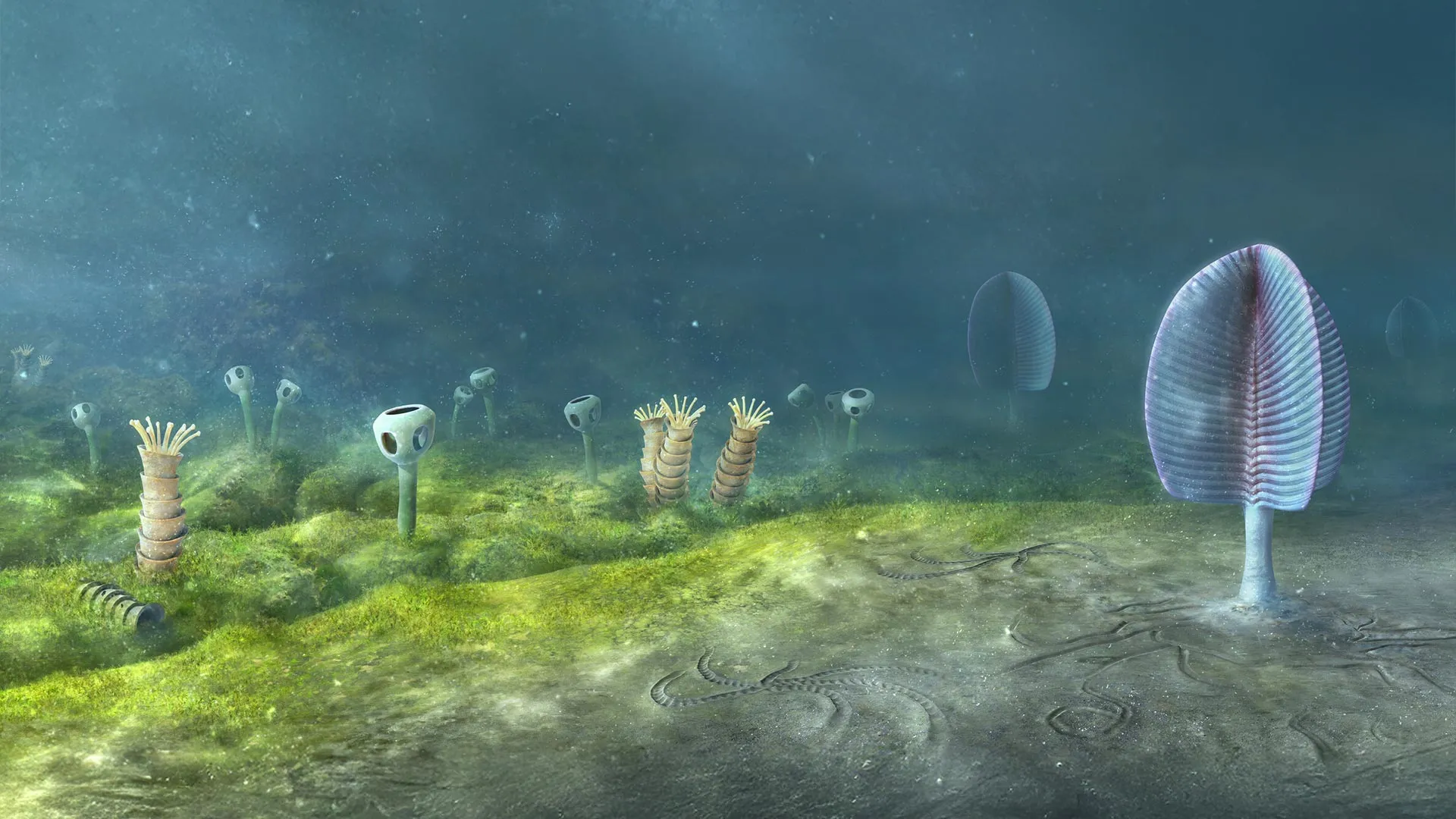
New research suggests animals may have evolved up to 200 million years before they first appear clearly in the fossil record, challenging a key assumption scientists have used to estimate when animal life began. A study led by the University of Oxford suggests the earliest animals may have existed hundreds of millions of years before the first unmistakable animal fossils appear. The findings, published Oct. 2 in Science Advances, indicate that animals could have originated deep in the Neoproterozoic Era, possibly before some of the most severe ice ages in Earth's history.
The research could reshape scientists' understanding of a major evolutionary puzzle. Animals seem to appear relatively abruptly in the fossil record shortly before the Cambrian Period (539 to 487 million years ago), even though other lines of evidence have long suggested their evolutionary story began much earlier. At the center of the new study is a question about how researchers have used ancient fossil deposits to place a maximum age on the origin of animals.
One important site is the Weng'an Biota in China, a roughly 590 million year old fossil deposit preserved in rocks of Ediacaran age. The site contains microscopic organisms preserved in exceptional detail, but none can be definitively identified as animals. Because of this absence, scientists have previously argued that animals likely evolved after the Weng'an Biota formed.
The reasoning was that if animals had already existed at the time, such an unusually well-preserved fossil deposit should have captured evidence of them. The new research calls that assumption into question. The international team, which included scientists from the University of California Berkeley, ETH Zürich, and Yale University, conducted an extensive study of exceptionally preserved microfossils from the Kheseen Biota in Mongolia.
The Kheseen Biota is more than 40 million years younger than Weng'an, although the two fossil assemblages share some species. Importantly, animals are already known from other locations around the world by the time the Kheseen Biota formed, including sites in Namibia and South China. Researchers examined more than 140 samples, including material collected from previously undocumented locations, using scanning electron microscopy.
Their analysis revealed exquisitely preserved new microfossil species, including acritarchs (tiny spherical organisms with spines and branching projections), along with embryo-like fossils containing internal cells. Despite the remarkable preservation, none of the fossils can confidently be identified as an animal. Senior author Associate Professor Ross Anderson (Museum of Natural History, Oxford University) said: "The Kheseen Biota breaks the argument that the exceptional microfossils of Weng'an mean we would have seen animal fossils in the assemblage had they existed at the time.
Extract — continue reading at the source.