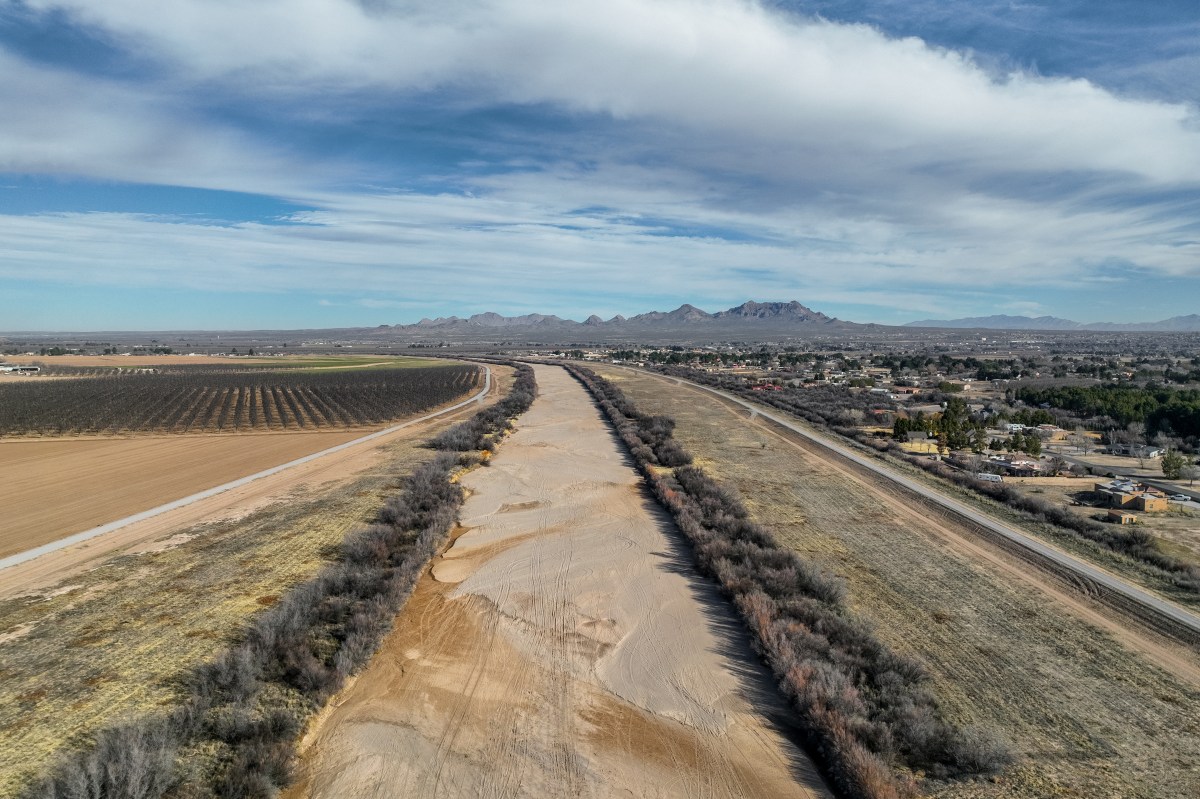
While concerns over the depletion of the Colorado River have dominated headlines in recent months, a longer river has been quietly battling “a severe water crisis demanding urgent attention." The Rio Grande has faced some of the most significant water shortages in the western United States, which could leave millions of locals without drinking water. Running 1,900 miles, the Rio Grande is one of the longest rivers in the U.S. It flows from Colorado to the Gulf of Mexico and provides water to several Mexican and U.S. states, including New Mexico and Texas.
With around 15 million people relying on it for drinking water, the Rio Grande is said to have lost around 85 percent of its historic flows due to overuse and major droughts for several years, the World Wildlife Fund noted in June. A spokesperson for New Mexico’s Office of the State Engineer (OSE) told Newsweek: “Despite recent rains, the New Mexico Office of the State Engineer and Interstate Stream Commission remain very concerned about the water outlook for the Rio Grande over the next few years and in the coming decades.” According to the OSE, the river has experienced some of “the most significant declines in flows among major river systems in the western U.S.,” including more than 112 miles of river drying this summer. During this water year, flows in New Mexico were about 31 percent of median levels, while August flows were about 14 percent of median levels.
Elephant Butte Reservoir was less than 1.5 percent full on August 31, the OSE spokesperson said, marking the lowest level on record for that date. The OSE said: “The state is actively working to address these challenges. Both the Rio Grande and Colorado River systems are critically important to New Mexico, and we are committed to working with other states and stakeholder partners to develop and implement solutions that protect New Mexico’s water resources.” According to the Texas Water Development Board's 2027 State Water Plan, Texas’ existing water supplies—those that can be relied on in a drought—are projected to decline by about 10 percent between 2030 and 2080.
Without new water supplies or water management strategies, "Texas water users could face water shortages of approximately 3.6 million acre‑feet per year by 2030, growing to 5.8 million acre‑feet per year by 2080, if drought conditions comparable to the drought of record recur," the TWDB said. Texas' largest reservoir, the Toledo Bend Reservoir, has a maximum storage capacity of about 4.5 million acre‑feet, "meaning projected annual shortages could exceed the full capacity of the state’s largest reservoir," the TWDB said. The OSE spokesperson said the Rio Grande's “significantly reduced and declining river flows” over the last decade, particularly over the past five to six years, are “occurring in the context of a changing climate and prolonged drought conditions.” A study published this month in Agricultural Water Management said: “Climate change has intensified the propagation of drought and the frequency and intensity of extreme weather events, posing severe challenges to global agricultural production and water resource management.” Timothy Parker, a groundwater expert who led several Rio Grande and New Mexico aquifer mapping/survey projects in response to the water shortage as a principal at Ramboll, a global engineering consultancy, told Newsweek that the Rio Grande water shortage is “real and very alarming,” He said that over the past two decades, “temperatures have gone up accompanied by drier years.” Parker says New Mexico’s agricultural water use, which has increased over the last 40 to 50 years as farmers switched from temporary crops to crops that require year-round water, has been “exacerbating the shortage.” He said that “this shift means that water is being consumed more constantly over wet years and dry years.” Irrigated agriculture accounts for 87 percent of direct water consumption in the Rio Grande basin, according to a November 2025 study in Discover Water led by Brian Richter, president of Sustainable Waters, a global organization focused on water scarcity challenges.
The November 2025 study notes that in recent decades, water storage reservoirs, aquifers, and annual streamflow volumes have been “substantially depleted, leaving little buffer for continued over-consumption of renewable water supplies.” The study warned that “without a substantial reduction of water consumption,” a repeat of the four-year rate of reservoir depletion seen from 2010 to 2013 would “completely wipe out all remaining surface water” stored in the basin. The study said: “All remaining water stored in New Mexico reservoirs could be gone in just one or two low runoff years.” Rich “Raz” Razgaitis, a national clean water and sustainability expert, told Newsweek that “climate change is shrinking the supply,” but “overuse is why there's no cushion left.” He noted that since 2000, snowmelt runoff, the Rio Grande basin's primary water source, has averaged about 17 percent below 20th-century levels. The OSE spokesperson said they remain hopeful that the current El Niño weather pattern may contribute to a good winter snowpack and snowmelt runoff in early 2027, but expect to see “approximately 25 percent less water in the Rio Grande by 2070.” Bill Kirk, CEO and co-founder of Weather Trends International and WeatherTrends360, told Newsweek that there are clear signs the 2025 La Niña drought pattern has “rapidly intensified to the strongest El Niño in 149 years.” Kirk noted that “this is dramatically changing the weather pattern in the U.S. and the Rio Grande River Valley between Texas and Mexico.” Kirk said the Rio Grande River Valley is already seeing this wetter pattern, and it is forecast to continue well into spring 2027.
Extract — continue reading at the source.