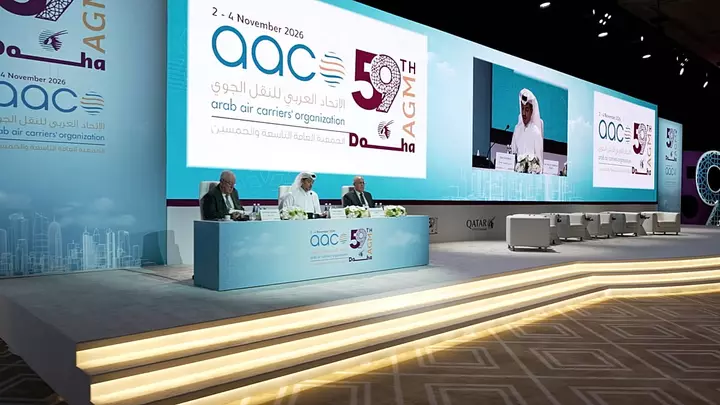
Following a turbulent year, Arab airlines are projected to suffer a multi-billion dollar loss, according to a report issued by the Arab Air Carriers' Organization (AACO). Meeting this week in Doha for its annual general meeting (AGM), AACO is an association of 39 Arab airlines based in the Middle East and North Africa, including carriers such as Qatar Airways, Emirates, Etihad Airways and Gulf Air. It provides a joint framework for cooperation among member airlines in areas like aeropolitical affairs, digital transformation and sustainable aviation fuel.
In its 2026 annual report, AACO highlighted that operational pressures related to “geopolitical uncertainties” and “fluctuating financial conditions” have hit the balance sheets of regional airlines. According to the findings, it’s forecast that AACO members will record a net loss of $4.3 billion (€3.82 billion) in 2026 and a 5.2% decline in air cargo traffic. Globally, the industry’s net profit is projected to fall to around $23 billion (€20.5 billion), its “lowest level in 12 years excluding the COVID-19 period and its aftermath”.
The report added that performance among members is “likely to vary considerably depending on hub locations and exposure to conflict-affected markets”. Despite the pressures, AACO said that the airline industry is “expected to remain profitable" in 2026, "albeit at a slower pace as higher energy costs and ongoing operational disruptions are placing additional pressure on margins”. Fuel is expected to take 31.4% of industry operating costs, and specifically for AACO members this comes to 37.3% – “up from 25.4% and 27.9% recorded respectively in 2025".
In Doha, concerns were raised over the EU's proposed Emissions Trading System (ETS), warning it could infringe on regional airspace and create unfair additional costs to Arab airlines. Abdul Wahab Teffaha, AACO's Secretary General, told Euronews Travel that ETS raised questions of “sovereignty”. In 2005, the bloc introduced ETS proposals, with the goal of requiring polluters to pay for their greenhouse gas emissions.
The aviation sector was brought into the EU ETS on 1 January 2012, however, the application for flights to and from non-European countries was suspended later that same year. During the AGM, the Resolution on Aviation and the Environment was adopted, opposing the extension of the ETS to flights departing from the European Economic Area (EEA) and landing in third countries within a 5,000-kilometre radius of Frankfurt Airport by 2029. "This is extra-territoriality, trespassing on the sovereignty of others,” said Teffaha, who added that the move would undermine the Chicago Convention.
Beyond sovereignty, Teffaha also told Euronews that if the ETS were to become law, Arab carriers could unfairly face double costs for their emissions reductions, given that the existing Carbon Offsetting and Reduction Scheme for International Aviation (CORSIA) framework already requires airlines to offset a proportion of their international flight emissions. As such, Arab carriers may end up paying double if the two frameworks do not recognise each other’s charges. The three-day event was hosted by Qatar Airways with Hamad Al-Khater, Qatar Airways Group Chief CEO, as the session's chairman.
Extract — continue reading at the source.