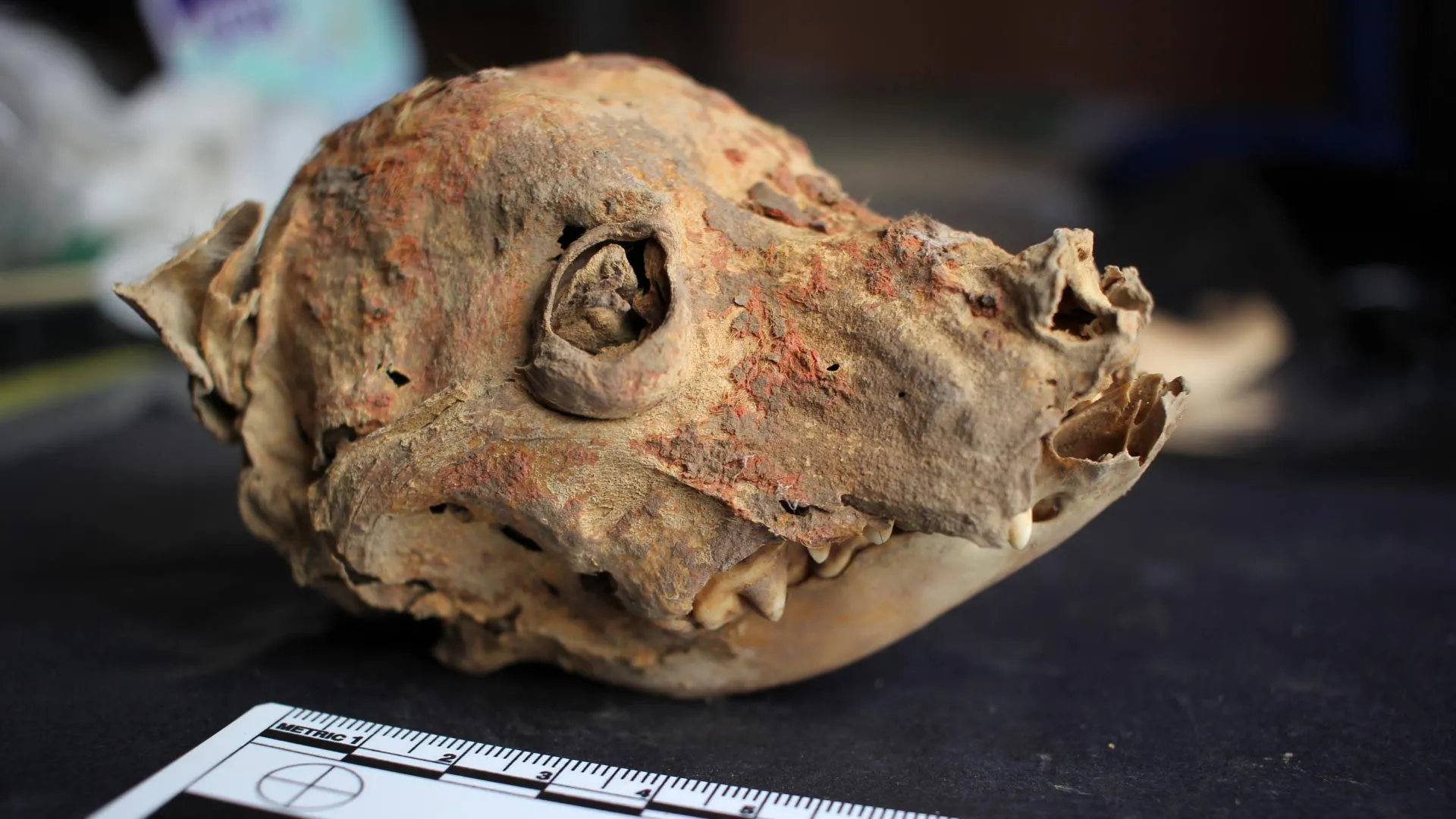
Archaeologists working at an ancient burial complex in Peru have uncovered remarkable evidence of hairless dogs that lived more than 1,200 years ago, long before the rise of the Inca Empire. The discoveries include naturally mummified remains, unusual skeletal features, and clues about what the animals ate and how they were treated by the people around them. Peruvian hairless dogs are a distinctive Indigenous breed known for their slender bodies, pointed ears, and lack of fur.
They frequently appear in pottery created by ancient societies along the Andean coast. Today, a variation of the breed is recognized by the American Kennel Club as the Peruvian Inca Orchid. The dogs are also an important national symbol, having been officially designated part of Peru's cultural heritage in 2000.
A study published in the Journal of Anthropological Archaeology reports the first physical evidence of Peruvian hairless dogs at Castillo de Huarmey, the only known Wari Empire site discovered so far on Peru's northern coast. Ancient Dog Remains Discovered at a Wari Empire Site Located approximately 190 miles north of Lima, Castillo de Huarmey covers 110 acres and once served as an administrative and burial center for the Wari Empire. The complex was occupied between 600 and 1050 CE, roughly 400 years before the Inca rose to power.
The site has already produced several extraordinary archaeological discoveries. In 2012, researchers uncovered the first undisturbed elite Wari tomb, containing the remains of 58 high-status women, six human sacrifices, and approximately 1,300 artifacts. Another important discovery followed in 2022, when archaeologists identified nearby burials of elite craftspeople accompanied by gold, silver, and bronze tools.
Together, these findings have helped researchers understand how the Wari Empire governed its territories. The newly examined dog remains offer a different perspective on daily life at the site, particularly the complicated relationships between people and animals. "Our findings indicate that humans and dogs coexisted at this Wari site, but reconstructing their bond is challenging, as past emotions are difficult to capture through archaeological methods," says first author Weronika Tomczyk, a research associate in Dartmouth's Department of Anthropology and a postdoctoral fellow in its Ecology, Evolution, Environment and Society Program.
"The goal of our study was to not only present data on Castillo de Huarmey's dog burials, but also emphasize that people in the past had often contradictory relationships with the animals, just as they do today: a pet for one group of people could at the same time be considered a pest by their closest neighbors." Remarkably Preserved Dog Mummies Found in the Peruvian Desert Castillo de Huarmey lies in an extremely dry region of Peru's Pacific coast. The desert's exceptionally arid conditions have helped preserve materials that would normally deteriorate over time, including hair, bones, clothing, leather, pigments, and decorated pottery. Among the artifacts recovered from the site is an unusual ceramic vessel depicting a seated Peruvian hairless dog with humanlike features.
Extract — continue reading at the source.



